
Get an international seat with American Airlines through little-known loopholes.
A Tale of Two A Seats: It was the best of times, it was the worst of times. It just depended on which flight you booked.
Let’s compare Seat 2A on two different American Airlines flights from Los Angeles to Dallas in Business Class: Seat 2A on Flight AA2462 and Seat 2A on Flight AA1631.
Same airline. Same route. Same “seat”—well, they’re both seat 2A.
But a world of difference.
Flight AA2462 uses an international aircraft—a B787—with international Business Class seats.
Flight AA1631 uses a domestic aircraft—an A321—with domestic Business Class seats.
On international flights, Business Class is usually Business Class. On domestic flights, however, Business Class (it usually goes by the name First Class) is a big come down in comfort and overall experience with American (Transcons being the exception). It’s like the car hire company giving you a Toyota when you could have had a Cadillac. Well they’re both cars aren’t they?
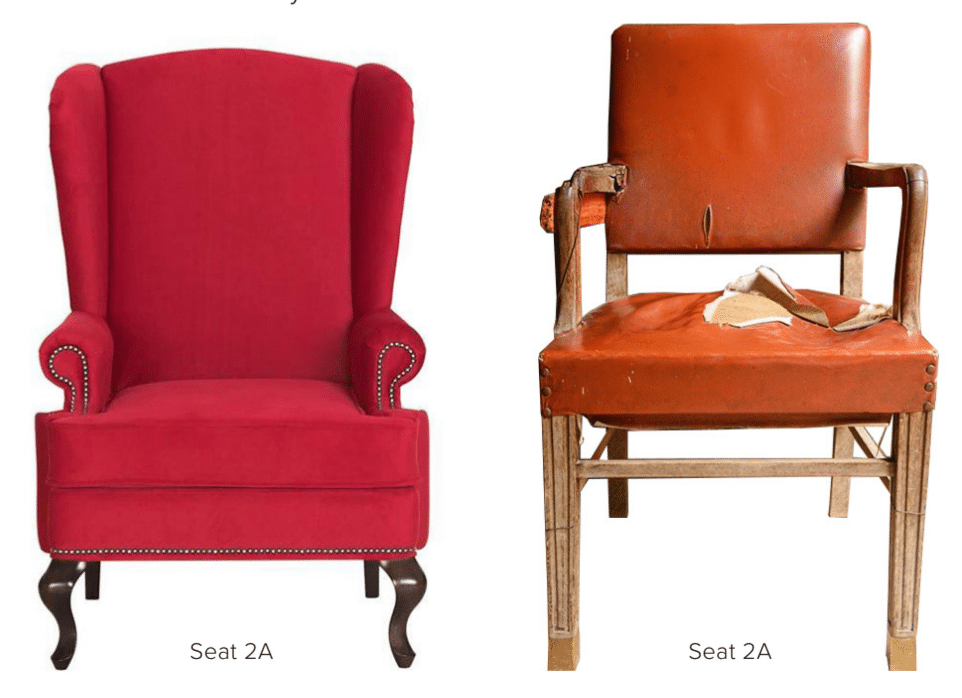
If you know the 65 different domestic flights on which American Airlines uses an international aircraft with international Business and First Class seats, you’ll have a simple way to get an “in-class seat upgrade”. How can you possibly know those 65 flights? Simply put your seat into the recline position, and read on.
It Starts with the Type of Aircraft
American’s B777-300ERs: On one route, Los Angeles-Miami, the airline’s three-class, internationally configured B777-300 offers the “Flagship” suite, which has a 30-inch-wide seat (with the armrest dropped) and converts to a 78-inch-long flat-bed. Seats are configured 1x2x1, and each has a 17-inch touchscreen monitor. (Business Class has the new flat-bed seat.)
American’s B777-200s: The carrier is in the midst of rolling out new seats; 29 aircraft have been retrofitted with new flat-bed Business Class seats: In a 1x2x1 layout, they are 21 to 26 inches wide and have a 16-inch touchscreen monitor. The remaining 17 aircraft will be retrofitted over the next few months and still have the old angled-seats (168-degree recline, 20 to 22.6 inches wide, and are in a 2x3x2 layout), and the old configuration also still has AA’s international First Class cabin, the retrofitted aircraft will not.
American’s B767s: The carrier has transitioned 24 aircraft (out of 33) with the new flat-bed Business Class seats: In a 1x2x1 layout, at 19.6 to 21.4 inches wide. The rest still, and will continue to, have the old angled-seats, as AA is in the process over the next few years of retiring those aircraft. While they’re much better than typical domestic premium seats, they’re also not nearly as good as the new ones.
American’s B787s: These have AA’s new flat-bed Business Class seats: In a 1x2x1 layout, they are 21 to 26 inches wide and have a 16-inch touchscreen monitor.
: These have flat-bed Business Class seats: In a 1x2x1 layout, they are 20.5 inches wide and have a 12.1-inch touchscreen monitor. (The A330s were once US Airways’ international aircraft, which AA integrated into the fleet after the merger.)
Why Pay Top Dollar for an Inferior Seat?
FCF’s insider cheat sheet below shows the current routes on which American uses an internationally configured aircraft and the flight numbers you can use to identify the opportunities when selecting flights through your travel agent or online. No matter if the aircraft has an old or new international premium seat; both are a superior product to American’s regular domestic First Class seats.
Where to find American's International First & Business Class Seats on Domestic Routes
[table_opt id="5568" style="gray-header" width="wide" alignment="thcenter" rows="tdcenter"/]
When to Pay Cash for an International Seat on a Domestic Route
Business Class fares for flights within the continental U.S. have taken a nose-dive over the past few years, to an extent, we think, that mileage upgrades and free mileage awards are very often not the better deal on many routes.
A good example is Los Angeles-Dallas, a route on which American flies the B757 and the internationally configured B787. If you book American flight AA2462 (a B787) with a new international flat-bed Business Class seat, the lowest domestic Business Class fare is $530 round-trip, the same as AA charges for the B757 flights. That makes an award ticket or upgrade pointless, given the return on miles of 1.2¢ or less.
When to Pay with Miles for an International Seat on a Domestic Route
[aside headline="Good Connections Count" alignment="alignright" width="half" headline_size="default"]Keep the flight numbers and routes in the chart in mind to get a better seat when connecting. When flying New York-Honolulu, for example, connect in Dallas to catch flight AA5; or when flying Miami-Sydney, you might consider a connection via Los Angeles to catch AA275.[/aside]
Mileage Upgrades—Cost-Per-Hour-to-Upgrade: Spending 30,000 miles to upgrade an eight-hour, round-trip flight is usually a good return on your miles; for 10+ hours of flying it starts to become a no-brainer: Even with the $150 surcharge, the cost-per-flight-hour to upgrade to Business Class is $15 (if you have the miles in your account) to $88 (if you must buy the miles).
Other reasons for wanting to use mileage upgrades instead of free awards are that they earn Elite Qualifying Miles (EQMs), Elite Qualifying Dollars (EQDs), and award miles on the paid ticket, which offset the miles you’ve spent for the upgrade. On the LAX-Miami upgrade from Business to First Class, you earn about 8,445 miles (based on entry level elite), reducing the mileage cost to upgrade from 30,000 to 21,555 miles.
Mileage Upgrades—The Seat Availability Secret for First Class: AA’s upgrade inventory on three-cabin aircraft comes from the same “availability bucket” it uses for many discounted First Class fares (booking code A). That means you are much more likely to get a confirmed upgrade than a free mileage award ticket, as well as a better return on miles.
Get an international seat with American Airlines through little-known loopholes.
A Tale of Two A Seats: It was the best of times, it was the worst of times. It just depended on which flight you booked.
Let’s compare Seat 2A on two different American Airlines flights from Los Angeles to Dallas in Business Class: Seat 2A on Flight AA2462 and Seat 2A on Flight AA1631.
Same airline. Same route. Same “seat”—well, they’re both seat 2A.
But a world of difference.
Flight AA2462 uses an international aircraft—a B787—with international Business Class seats.
Flight AA1631 uses a domestic aircraft—an A321—with domestic Business Class seats.
On international flights, Business Class is usually Business Class. On domestic flights, however, Business Class (it usually goes by the name First Class) is a big come down in comfort and overall experience with American (Transcons being the exception). It’s like the car hire company giving you a Toyota when you could have had a Cadillac. Well they’re both cars aren’t they?
If you know the 65 different domestic flights on which American Airlines uses an international aircraft with...