
The process is the same for careers, relationships, and anything else you want to improve
If you're not interested in improving your situation or getting more than average or below-average – instead of the highest-quality life experience possible – don't bother with this special report.
But if you're about to pull the trigger on your next ticket – or if you bought one and plan to live with what you've got – consider this: You might spend the next 16 to 24 hours round-trip wishing you'd taken 15 or 20 minutes on the ground to assess the various features of what you are about to purchase: seat quality, in-flight experience, privacy, cabin layout, and density, etc.
Minutes of diligence now can eliminate surprise and misery for hours at 35,000 feet.
This special report is intended to help you assess the parameters of the flight experience, identify the best sources for reality-based data, and ultimately, make the best decision for you.
You’ll also learn a new WAY to think that eliminates the complexity that otherwise overwhelms.
Harvard says we make 30,000 decisions a day.
What if there was a better WAY to go about those decisions?
This report is for you if you wish there were.
First things first.
YOUR TRIP STARTS WHEN YOU REACH THE AIRPORT,
NOT WHEN YOU ARRIVE AT YOUR DESTINATION
About to book a ticket? This is for you.
Already holding a ticket? This is for you, too.
WHEN THIS INTELLIGENCE APPLIES
Travel happens in four phases – and The Anything ProcessTM (aka The Upgrade ProcessTM) follows The Five Steps.
Every time.
Understanding where you are determines how you apply this intelligence.
THE FOUR PHASES OF TRAVEL
- Phase 1 – Dreaming: Exploring random possibilities
- Phase 2 – Planning: Narrowing to specifics
- Phase 3 – Booking: Making purchase decisions
- Phase 4 – Post-Purchase: Improving what you have
THE FIVE UPGRADE PROCESS STEPS
- Step 1 – Baseline: What’s my starting point? What am I upgrading or improving FROM?
- Step 2 – Desires: What are my goals and requirements? What do I want to upgrade TO?
- Step 3 – Options: How can I get what I want?
- Step 4 – Decisions: What option will I choose?
- Step 5 – Implementation: Making it so.
AHHH LIFE’S COMPLEXITY SIMPLIFIED IN 5 WORDS
If you're in Trip Phase 3 (Booking): Use this intelligence for Process Step 3 – collecting and assessing competing flight and seat options.
Should you decide to book the carrier with new Business Class seats but with a less favorable schedule than the one with older seats?
Which airline's product and schedule actually match your priorities best?
If you're in Trip Phase 4 (Post-Purchase): Use this intelligence for Process Steps 1 – knowing your baseline so you can identify genuine upgrade options.
You've got a ticket on an older aircraft with seats 18 inches wide. Is upgrading to a newer configuration with 22-inch seats worth pursuing? Also, use Process Step 3 when you’re holding a ticket to evaluate potential upgrade options against your current booking’s baseline.
THE UPGRADE INTELLIGENCE PRINCIPLE:
COMPARING FLIGHT OPTIONS
This is what decision intelligence looks like: having concrete data about competing flight options before choices are locked in. This isn't about choosing between seat 5A or 5B in the same cabin, although you may want to check that out too before you purchase. Knowing the reality of what IS available beats being wishful. This is about comparing fundamentally different product options.
Should you fly Emirates or Qatar? Do the Delta flights I’m looking at have the new seats or the airline's waaaaaaay old seats?
One carrier's Business Class seats are 21 inches wide and fully recline with privacy doors, while another's has 18-inch seats with less legroom. These are different experience options at similar prices – if you know what to assess.
The difference between "good enough" and "best possible" is often just knowing what distinguishes one flight option from another. Same route, same cabin class, vastly different comfort level. But you need specific information to assess the differences.
The Anything Process “Career Parallel”: This is exactly how smart job seekers operate. They don't just compare titles – they evaluate actual team dynamics, growth trajectories, and compensation structures across competing offers. Same intelligence, different laboratory.
The intelligent move is identical: Collect the attributes that distinguish options according to your desires, assess them in reality (against your baseline), and decide deliberately – BEFORE you implement.
This is The Anything ProcessTM (aka The Upgrade ProcessTM), because anything you do in life follows it.
Either unconsciously or consciously.
And either wishfully or deliberately.
Right?
THE THREE REASONS FLIGHT DECISIONS FAIL
People who end up disappointed with their flights – whether booking or upgrading – typically fail for one of three reasons. This Upgrade Intelligence framework addresses all three.
1. Not Deliberate: They wing it, hoping things work out. They book whichever option looks reasonable without assessing what distinguishes competing flights. They discover the issues at 35,000 feet when it's too late to change.
2. Uninformed: They guess instead of gathering data. They assume "Business Class is Business Class" and miss the fact that Emirates operates both an exceptional First Class product and a below-average Business Class. Or that Delta's newest aircraft offer dramatically better seats than their legacy fleet, although at similar prices.
3. Fantasy vs. Reality: They believe marketing materials without checking variant-specific details. Ever booked "lie-flat" only to discover it means "angled at 170 degrees"? Ever trusted "premium economy" only to find it's just a couple of inches more legroom than regular economy?
The airline's general reputation tells you nothing about the specific seat on your particular flight.
Career Parallel: Ever been surprised after a few days on a new job? Same pattern – trusting the recruiter's pitch about "great culture" instead of doing diligence on the actual team you'd join. The company's reputation matters less than the specific team, manager, and role.
Relationships Parallel: Believing what an improvement option "should" feel like instead of honestly assessing what it actually means when implemented.
The Upgrade Intelligence move is identical across any domain in life: deliberate assessment beats wishful guessing.
BEYOND PRICE AND SCHEDULE:
THE ATTRIBUTES THAT DISTINGUISH FLIGHT OPTIONS
Everyone evaluates price and schedule; those are obvious. But once you've narrowed those down, you need to go deeper. What actually distinguishes one flight option from another?
There are infinite possible attributes to assess. Below are the 18 most common ones that are easily quantifiable and distinguish mediocre flights from exceptional ones.
START WITH SEAT INTELLIGENCE
For me, three attributes matter most: seat width, legroom (pitch), and recline. These are the physical dimensions that distinguish comfortable flights from cramped ones generally speaking.
If you’re like me at 6’3” with broad shoulders, a seat 22 inches wide versus 18 inches is the difference between spacious and constrained. A 76-inch pitch versus a 60-inch pitch means sleeping flat versus curling up. Full lie-flat versus angled-flat might determine whether you arrive rested or exhausted.
But everyone prioritizes differently. Is the in-flight entertainment screen size most important to you? No problem – you can get that data. Wi-Fi availability and pricing? Refundability for schedule changes? Aircraft type for cabin pressure and noise? All available. The intelligent move is figuring out which attributes matter most to YOU, then assessing that information to distinguish competing flight options.
OTHER ELEMENTS OF THE EXPERIENCE
Beyond seat dimensions, consider what distinguishes flight options:
- In-Flight Entertainment content variety (strong library versus minimal selection makes 12 hours manageable or miserable)
- Wi-Fi availability and pricing (essential for business travelers, varies wildly by carrier and aircraft)
- Privacy features (suites with doors versus open cabins)
- Cabin density (24-seat Business Class versus 60-seat high-density configurations)
- Direct aisle access (no climbing over others)
- Refundability and change fees (flexibility when plans shift)
These are just a few.
A list of the most common flight option attributes appears in the reference chart below. Pick your top three to five priorities – you don't need to assess all 18. That's the efficiency principle: Ten minutes of focused diligence distinguishing real differences beats 19 round-trip hours of regret at 35,000 feet.
Again, if you’d rather spend your time doing something else than getting the highest-quality life experience possible on your trip, no judgment. Everyone’s taste is different, and of course, you know my bias.
Thank heavens I’m not alone. I’ve heard many a well-heeled traveler say their premium flight experience was as memorable as anything on their trip.
WORK SMART:
DELEGATE THE DATA COLLECTION
This Upgrade Intelligence framework is perfect for delegation. Work with your travel agent, administrative assistant, travel companions, or whoever to collect these attributes for competing options. Give them your top three to five priorities or more, and the flight options you're assessing. Let them build it into your decision process.
Once you establish your dominant desires, this gets faster on every trip – you're building a system, not starting from scratch each time. FCF is working on a tool for this.
YOUR INTELLIGENCE TOOLKIT:
FIVE TOOLS
Distinguishing flight options requires accurate, variant-specific data. These five resources provide seat dimensions and cabin configurations, but they vary dramatically in reliability and freshness. Here's how to use each one strategically when comparing competing flights.
THE SEARCH OPTIONS FOR ASSESSING FLIGHT OPTIONS
AeroLOPA
The most accurate and detailed resource for aircraft cabin layouts, covering over 90 airlines. Each variant-specific page outlines exact seat models, configurations, and technical specs – such as seat pitch, width, recline, and bed length – plus design features like headrests, tray tables, storage spaces, display size, and power outlets. Every page shows when it was last updated, ensuring you know how current the information is. For accuracy and reliability, AeroLOPA is the benchmark source.
SeatMaps
Offers the widest airline and aircraft coverage available, with variant-specific seat maps showing pitch, width, and recline. Interactive maps let you hover over individual seats to view color-coded comfort ratings, written seat reviews, and linked traveler photos. While it excels in accessibility and user feedback, it provides less detail on cabin components and seat design features compared to more technical sources. Use it as a broad, fast way to compare flight comfort across fleets.
SeatMaestro
Covers 178 airlines and lists basic specifications such as seat pitch, width, and total seat count. Some aircraft pages include only partial data—often just seat width and number of seats. It includes traveler reviews, though photos are limited and typically negative in tone. There are no single-seat reviews or cabin feature details, and the database is largely outdated. SeatMaestro is best used as a secondary reference for quick verification.
SeatGuru
Once the go-to resource for travelers, SeatGuru provides aircraft layouts and in-flight cabin details across a wide range of airlines. It lists seat pitch, width, and recline, along with basic information about entertainment and power options. However, some listings are vague, updates have been infrequent for several years, and there are no seat photos. Use SeatGuru primarily when researching older aircraft or cross-verifying cabin information.
Airline Websites
The most direct and trustworthy source for official seat and cabin information. Most airlines list verified data such as seat pitch, width, recline, and onboard amenities like entertainment and Wi-Fi. Some, like Delta, go further – providing accessibility information, including which seats have movable armrests. However, few sites include full cabin layouts or seat models, so it’s best to cross-check with alternate sources that offer more detail on which seats are best to choose.
EXAMPLE Scenario 1:
American Airlines Dallas - London
The One-Digit Upgrade 777 vs 787-P
A single number can separate standard from standout.
Scrolling through Business Class options from Dallas to London on AA.com, you’ll find multiple flights. Same route, same price, almost the same time. One shows a 772, the other a 78P. It looks like a minor code difference – until something catches the eye: the “Flagship Suite” banner next to the 78P flight.
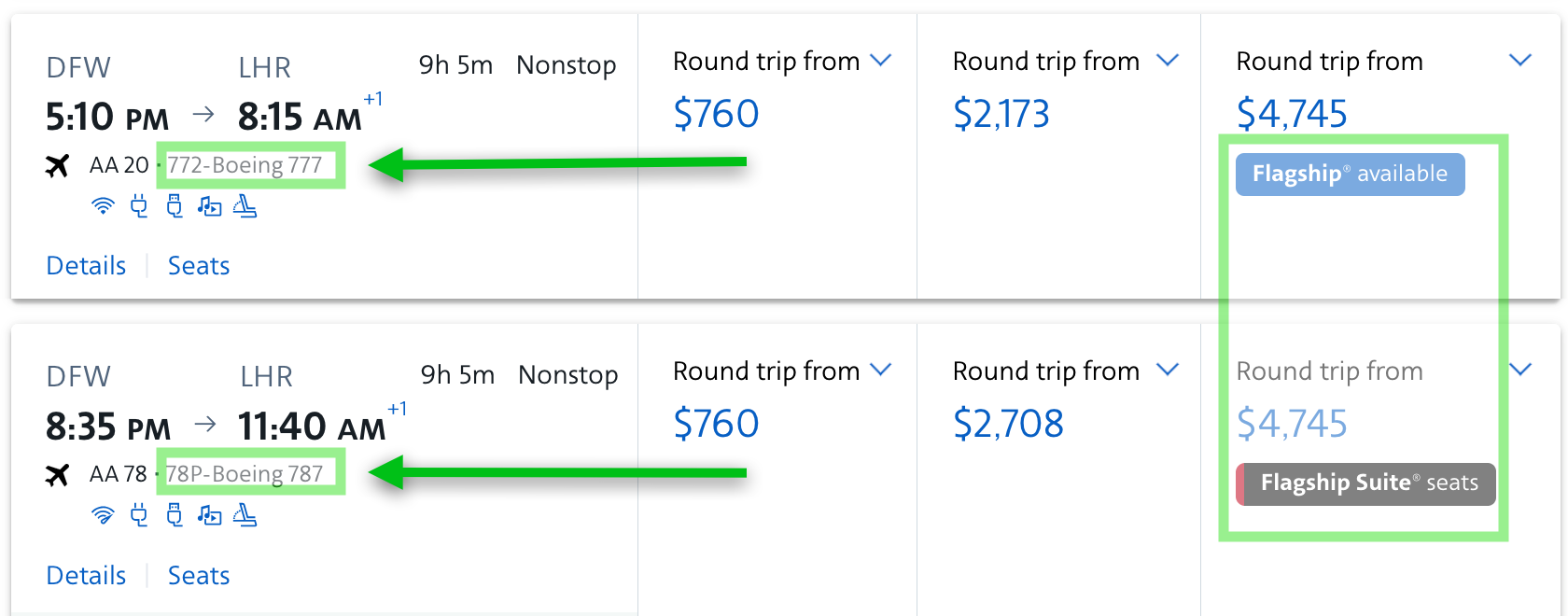
That’s when the options-intelligence antenna sparks to life. A small aircraft variation often hides a major upgrade in comfort.
A glance at AA.com’s fleet page shows the 772 still flying American’s older Business cabin – open layout, aisle exposure, and dated finishes. Then, a quick check on AeroLOPA confirms what that “Flagship Suite” tag promises: the 78P introduces American’s newest Business Suite, complete with sliding doors, expanded work surfaces, mood lighting, and a modern design built for privacy.
Both fares are identical. The 787-9P simply departs 1 hour and 45 minutes later. The trade-off? A short wait for a completely different world – more space, more rest, and total privacy.
Catching that single digit turns an ordinary flight into an exceptional one.
EXAMPLE Scenario 2:
ALL NIPPON Salt Lake City-Tokyo The Connection-CITY
UPGRADE ANA’s “The Room”777 vs 787-P
The right connection can transform the entire onboard experience – often for the same fare.
Take Sam from Salt Lake City on a trip to Tokyo. He notices two ANA Business Class options: one connecting through Los Angeles and another through San Francisco. Both are ANA-operated and similarly priced, yet a subtle difference appears – the aircraft type. The Los Angeles routing shows a Boeing 787-9, while the San Francisco flight lists a Boeing 777-300ER.
That single detail triggers the options-intelligence antenna. Different aircraft frequently mean different seat products. Instead of selecting the shorter layover, the Sam takes 90 seconds to confirm the details:
- On ANA’s website, he discovers the Los Angeles flights use ANA’s older, staggered 2-2-2 configuration with limited privacy.
- He goes to AeroLOPA and hovers over the 777-300ER seat map, and it reveals ANA’s flagship “The Room” suite: a 1-2-1 configuration featuring an extra-wide seat, a 4K screen, and full-height sliding doors for total privacy.
The Los Angeles option delivers an exposed, decade-old design, while the San Francisco routing – departing only 1 hour and 45 minutes later – offers one of the most advanced Business Class products in the sky.
The result: a five-star Business Class experience instead of three stars, complete with a closing door.
Ninety seconds of research turns a routine flight into a world-class journey.
WHAT THIS INTELLIGENCE DEMONSTRATES
This is Process Step 4 – decision criteria collection – in action. Upgrade Intelligence means knowing your evaluation criteria before you decide among options.
It’s human to implement prematurely.
Whether you're in Travel's Phase 3, comparing flight options to book or Phase 4, evaluating upgrade options against your baseline, you're using the same intelligence move: identify what matters, collect real data, and evaluate.
You're being deliberate (comparing deliberately, not winging it), informed (using data to distinguish among options, not guessing based on reputation), and reality-based (using variant-specific facts, not marketing fantasy).
The reference chart below shows the 18 most common attributes that are most quantifiable, with sources and rationale. Start with your top three to five. Build them into your decision process. Watch how quickly "they're all basically the same" becomes "here's exactly why this option is better for me."
TAKE MINUTES UP FRONT TO AVOID HOURS OR YEARS OF MISERY LATER
The WAY to get the highest quality flight is the same WAY to improve your career, your relationships, your health, and your business – anything you want to improve.
That’s why we also call The Upgrade ProcessTM The Anything ProcessTM.
Know your baseline. Identify your desires. Assess your options. Decide deliberately. Implement. The domain changes, but the intelligence doesn't.
Approach your next trip deliberately, informed, and reality-based. You will improve upon, or upgrade, what you would otherwise have done. Just use the cheat sheet below, or better yet, hand it to your assistant.
Remember: Your trip starts when you reach the airport, not when you arrive at your destination.
The hours in between matter.
Take to the skies with your eyes wide open.
See you up front – on a lot more than just flights.
Flight Experience Quality Assessment Cheat Sheet
The process is the same for careers, relationships, and anything else you want to improve
If you're not interested in improving your situation or getting more than average or below-average – instead of the highest-quality life experience possible – don't bother with this special report.
But if you're about to pull the trigger on your next ticket – or if you bought one and plan to live with what you've got – consider this: You might spend the next 16 to 24 hours round-trip wishing you'd taken 15 or 20 minutes on the ground to assess the various features of what you are about to purchase: seat quality, in-flight experience, privacy, cabin layout, and density, etc.
Minutes of diligence now can eliminate surprise and misery for hours at 35,000 feet.
This special report is intended to help you assess the parameters of the flight experience, identify the best sources for reality-based data, and ultimately, make the best decision for you.
You’ll also learn a new WAY to think that eliminates the complexity that otherwise overwhelms.
Harvard says we make 30,000 decisions a day.
What if there was a better WAY to go about those decisions?
This report is for you if you wish there were.
First things...