
We discovered the amazing EasyUp Business and First Class fare trend late last year and we’ve chronicled the trend’s volatile evolution in great detail in FCF’s Monthly Upgrade Advisors and in FCF Daily Alerts ever since.
There has been a mixed bag of feedback from FCF members on the trend, ranging from “Thanks for the amazing heads-ups!” to “Why can’t I find the fares!”
The Cure to Fare-Finding Frustration
This piece is meant to help, through an “EasyUp Fare-Finder Checklist,” for those of you who fall into latter group; and for those who have had amazing success, hopefully this will keep you there.
You may call this your guide to booking EasyUps (or any special fare we pass your way). First a quick recap of key items about EasyUp fares.
EasyUp Fares Defined
“EasyUp” is a term that fit the new fare trend’s essence—a low economy fare with an automatic upgrade for a relatively low surcharge. It’s a ‘no-brainer’ to book because you don’t’ have to jump through many upgrade strategy hoops. Thus the name EasyUp.
The airlines that introduced the fares, Delta and American, did it on the sly, to see how they would take.
Since then the fares have evolved, but much of the DNA is still the same—60-day advance purchase and 10 day minimum stay requirement—with the key element being that fares have dropped significantly from what they were just six months ago. So oftentimes there’s no need for monkeying around with other more complicated upgrade strategies.
Now You See Them, Now You Don’t
EasyUp fares change daily, sometimes hourly, which is why we often add the prefix “Flash” to EasyUp. The fares are the most volatile I’ve seen in more than 19 years of closely analyzing premium air travel opportunities. Because they are often short-lived, we cover the opportunities in FCF Newsroom postings almost daily.
Why Aren’t They Easier to Find?
Three major reasons: restrictions, fare changes, and availability. Here’s how to handle each of these:
Restrictions
They’re strict. A 60-day advance purchase usually and often a 10-day minimum stay, although it can be 7 or 8 days at times. The travel validity period is exactly what it is: Try to buy 59 days out and you’re out of luck. You also have to meet all of the restrictions—no cherry-picking allowed.
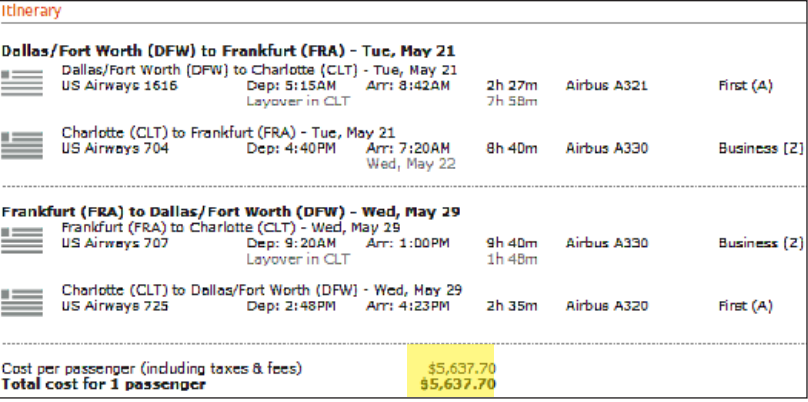
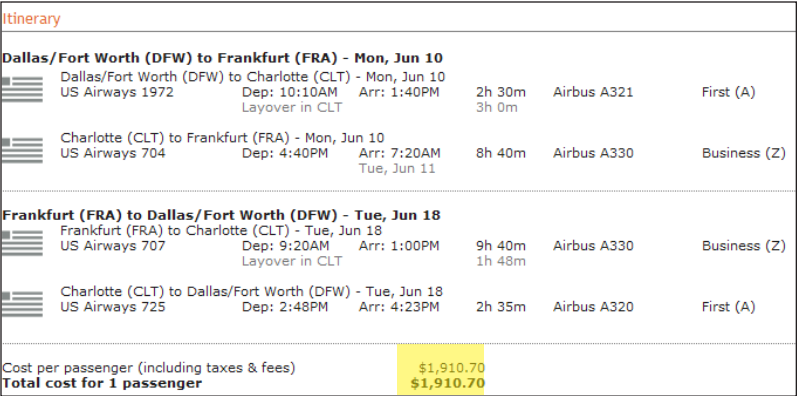
Let’s say you wanted to take advantage of our US Airways March 20 fare alert—$1, 911 Dallas-Frankfurt—for travel May 21 to May 29. You’ve got the minimum stay requirement, your dates are within the travel window and departure-return window, but you’ve missed the 60-day advance purchase requirement. That bumps the fare to at least $5,638 on US Airways, the lowest fare for these dates (see below). But compare that with June 10 to June 18.
Travel May 21 to May 29
Travel June 10 to June 18
The list of rules can be overwhelming. On average, each airline lists more than 30 fare rules, some with sub-rules. It can be like the IRS rulebook. Multiply that by 10 airlines on a route and we’d be sending you the War and Peace fare alert if we detailed everything.
Which is why we only list the major rules:
✔ Advance purchase
✔ Departure and return travel days
✔ Travel season
✔ Minimum and maximum stay requirement
✔ Booking codes
Focus on these five parameters and you can become a fare-finding pro fast.
Availability Codes
They’re a really important part of fare deals. Lufthansa’s EasyUp Business Class fare is booked in P class. If P is sold out, however, then that’s that. You must go to a higher fare code if you want that specific flight. Juggle your dates or routing a bit, and you might have more luck.
[aside headline="EasyUp Fares Gaining Popularity in the Airline Community" alignment="alignright" width="half" headline_size="default"]More airlines are offering these fares and more often. Even British Airways and Virgin Atlantic, two hold-outs when it comes to discounting usually. The fares have also spread to South America, in addition to Asia and Europe. On the downside, EasyUp fares to Europe have gone up a bit in some cases, while fares to Asia remain more stable.[/aside]
Let’s use Lufthansa’s March 11 fare alert—$1,728 Boston-Madrid—and say the travel dates are July 4 to July 14. You meet the restrictions, but Lufthansa’s P inventory is sold out for the departure, but is available on the return. Your fare will now be a combination of a higher Z Business Class fare for the outbound and the much lower P fare on the return—giving you a fare of $3,218. If only Z were available, the price would rise to $4,658. The reason is essentially due to the limited number of seats allocated at the special fares.
It can seem like these fares have become tantalizers, with very restricted inventory, if you don’t try different dates, routings, or even origin and destination airports, and are able to jump on them when they surface.
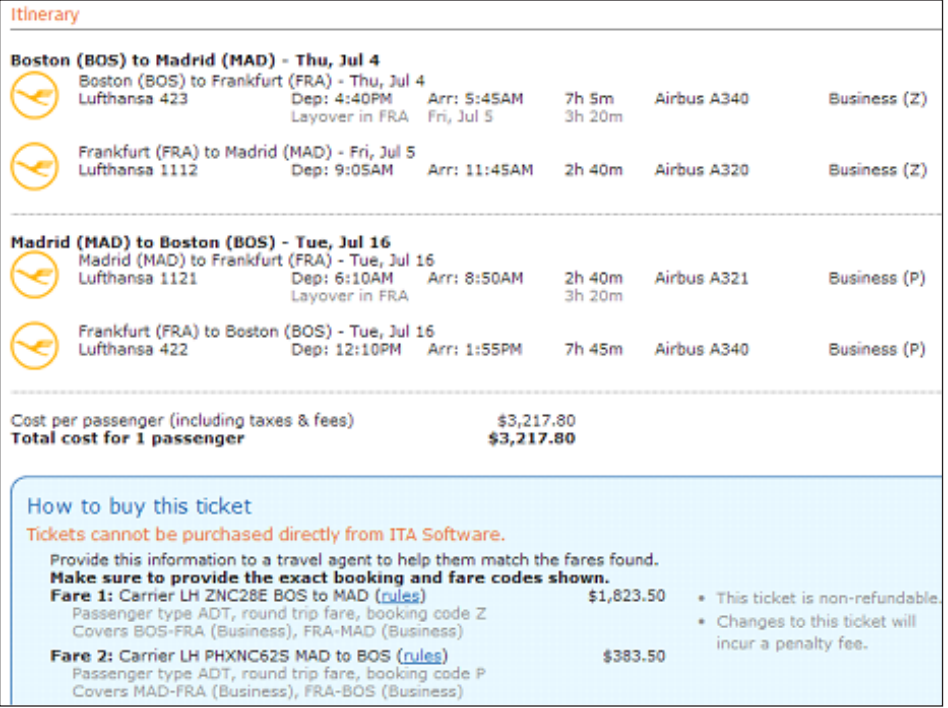
Fare Changes
FCF has had to cancel newsroom alerts because of EasyUp fare changes or evaporations. With EasyUps, there’s one cardinal rule: Book now or wait till they resurface. The next day, or even next hour, is ancient history. The kicker: The fare may come back. You have to stay on the ball. So use the alerts as a memory aide—if you miss an opportunity, go back and check the airline website and see if the fare is flying again.
Last Resort
Speak with an international rate desk agent, not a general reservationist (an order taker). International rate desk agents are usually available upon request. Provide the fare code and restrictions and ask them to look for a “fare list.” You’ll sound like an insider. A good travel agent can make the difference as well.
We discovered the amazing EasyUp Business and First Class fare trend late last year and we’ve chronicled the trend’s volatile evolution in great detail in FCF’s Monthly Upgrade Advisors and in FCF Daily Alerts ever since.
There has been a mixed bag of feedback from FCF members on the trend, ranging from “Thanks for the amazing heads-ups!” to “Why can’t I find the fares!”
The Cure to Fare-Finding Frustration
This piece is meant to help, through an “EasyUp Fare-Finder Checklist,” for those of you who fall into latter group; and for those who have had amazing success, hopefully this will keep you there.
You may call this your guide to booking EasyUps (or any special fare we pass your way). First a quick recap of key items about EasyUp fares.
EasyUp Fares Defined
“EasyUp” is a term that fit the new fare trend’s essence—a low economy fare with an automatic upgrade for a relatively low surcharge. It’s a ‘no-brainer’ to book because you don’t’ have to jump through many upgrade strategy hoops. Thus the name EasyUp.
The airlines that introduced the fares, Delta and American, did it on the sly, to see how they would take.
Since then the fares have evolved, but much of the...