
In FCF’s quest for the truth, we bring you news that isn’t always good. But our position is that information, research, and analysis make you a better traveler. It also allows all of us to better predict future trends.
Which brings us to Delta Air Lines.
Delta has long been the most innovative of the big three U.S. airlines in several ways. Such as selling discounted Business Class fares to Europe as an Up Fare, and offering a new version of Off-Peak Domestic First Class Fares for example.
And now Delta is at it again, although in this case, the benefits are decidedly in Delta’s favor, not yours. Surprised?
Segmentation. Not Just a Marketing Term.
In a recent interview, Delta CEO Edward H. Bastian said, “We’re a marketing company, not just an airline. We also have to price, we have to sell, we have to market to consumers.”
In November 2015, Delta put many items from that list into practice with the introduction of Delta Comfort+, a dedicated cabin segment with its own booking code, in effect a third cabin on a two-cabin flight. It’s a Premium Economy option with extra leg-room (up to four more inches) and preferred check-in, an upsell option that costs extra. Tick the box and up you go. Not way up, just a little bit up.
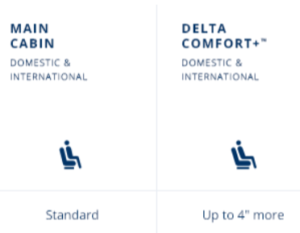
Well, now, Comfort+, the same product, costs much more. “With 200 million Delta customers every year, every nuance counts,” said Mr. Bastian.
We’re now seeing the effects of that decision.
A Little Goes a Long Way
For Delta, profit and shareholder value comes from incrementally getting more money from the least change or effort. That’s basic math, right? Airlines are great at math.
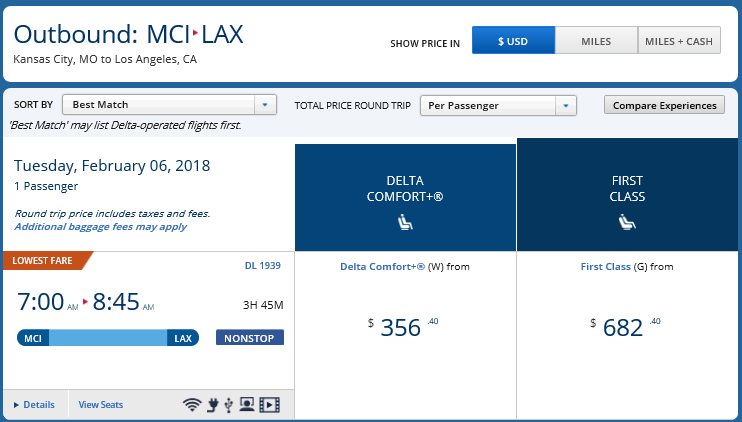
Let’s look at an example involving Kansas City and Los Angeles. In December 2016, First Class fares between those cities were $402 round-trip. At that time, Delta Comfort+ was $272. Now, a Comfort+ seat with its four extra inches of legroom is $356, while First Class is $682. Ah, the price of segmentation.
Delta.com screenshot, latest pricing:
Comparing Delta’s 2016 Domestic First Class Fares to 2017 Fares
[table_opt id="5943" style="gray-header" width="wide" alignment="thcenter" heading="thcenter" rows="tdcenter" responsive="no" /]
When it comes to low domestic First Class fares, Delta has gone from maven to miser, charging more than the competition in many cases. Compare United and Delta’s First Class round-trip on the Denver-NYC route. United charges $723 while Delta costs $869. On Los Angeles-Atlanta First Class round-trip, American Airlines charges $839, while Delta’s fare is $1,095.
What Does it All Mean for the Future?
FCF Predictions: American and United will follow suit some time soon. Both airlines are currently selling their domestic Premium Economy product as an upsell ancillary seat product from economy only. Look for them to make it available for purchase as a fare product with its own booking code.
The domestic First Class name could disappear; companies answerable to shareholders and their penchant for social media aren’t as likely to put all their executives up front for a two or three hour flight. In this egalitarian zeitgeist (at least on the surface), we envision domestic First Class being re-branded as Business Class (same product as before, just a different name).
Think about it: For companies, employees will be “doing business,” not fancy-schmancying it up front. For those employees, the service will be the same (it’s just a name change, after all), and they’ll feel better about saying they fly in Business. Is the domestic “First Class” name going the way of the dodo bird? Time will tell.
There’s another option: airlines change the name of their domestic Premium Economy offerings to Business Class. (Don’t laugh, that’s been going on in Europe for years.) Again, it sounds like an upgrade and they can probably charge even more for domestic First Class. Gotta love that segmentation.
Elite Upgrades
It could also make sense, from Delta’s perspective, when it comes to elite passengers looking to upgrade. Maybe, at some point, Comfort+ will be the free upgrade for lower-tier (if not all) elites. As elite programs are now driven by how much one spends, why should lower elites, who spend less, even get the promise of an upgrade to First Class? It’s an upgrade, but not as you know it—and maybe only top elites get the promise of an upgrade to Business Class.
American Upholding The PE Flag
American is leading the way among U.S. airlines in rolling out a true Premium Economy product. It launched its new PE seats on its first 787-9 in October 2016, and “after gauging its success”, the airline began an ambitious PE retrofit program for its other long-haul aircraft in 2017. By the end of 2017, the airline planned to have 63 wide-body aircraft with premium economy seats installed. American only sells Premium Economy tickets when it’s a true Premium Economy seat offered. For that reason we’d have thought American would have gone to the third-cabin domestic fare idea before Delta. If and when AA does, now AA will have a more legitimate claim to the third-cabin domestic fare.
See last month’s special report focused on United’s coach upsell option: Coach For Barely Less Than First? Don’t Get Schmucked by United.
In FCF’s quest for the truth, we bring you news that isn’t always good. But our position is that information, research, and analysis make you a better traveler. It also allows all of us to better predict future trends.
Which brings us to Delta Air Lines.
Delta has long been the most innovative of the big three U.S. airlines in several ways. Such as selling discounted Business Class fares to Europe as an Up Fare, and offering a new version of Off-Peak Domestic First Class Fares for example.
And now Delta is at it again, although in this case, the benefits are decidedly in Delta’s favor, not yours. Surprised?
Segmentation. Not Just a Marketing Term.
In a recent interview, Delta CEO Edward H. Bastian said, “We’re a marketing company, not just an airline. We also have to price, we have to sell, we have to market to consumers.”
In November 2015, Delta put many items from that list into practice with the introduction of Delta Comfort+, a dedicated cabin segment with its own booking code, in effect a third cabin on a two-cabin flight....