
How to use FCF’s New Connection Widget to Snag a Deal to Asia.
Last month, FCF released its new “Sweet Redeem (SR)” widget for travel to Europe. It highlights mileage programs that offer a free add-on connection in the U.S. and Europe, so even if your departure city isn’t mentioned in a Newsroom Alert headline, you can still often get the mileage award, with the help of the Sweet Redeem Widget. For details go here.
Now we’re telling you how to use the Sweet Redeem Widget for travel to Asia.
In general, the Asia widget is like the Europe one: Scour the FCF Newsroom for a deal on the long-haul route, then use the Widget to get an idea of the connecting flights that can potentially be made to/from the gateway/s.
However, when it comes to the details, the story changes. Add-on connections are not always free to Asia, and two mileage programs, even ones that use the same type of award chart, may differ greatly in their offerings on a given route.
That’s mainly because, unlike Europe (one zone), Asia is so big that the carriers have divided it into a number of regions or zones—at least two (Air Canada) and as many as seven (Singapore Air).
Take First Class Los Angeles to Tokyo on Singapore Airlines: The ticket costs 190,000 Singapore miles round-trip, and doesn’t allow a free domestic U.S. add-on flight to reach the gateway. That costs 35,000 miles more.
The same goes on the other end, for example, if you’re traveling on to Bangkok. That city costs 46,000 more miles because it lies in a different zone. Total cost: 236,000 miles. This is often the case on Asian routes, whether on an Asian carrier or not.
The point is that we don’t want you to zone out because you live in Omaha or Orlando and don’t see a deal from there to Bangkok or Hong Kong. FCF’s Sweet Redeem alert will help you see where the potential is for the long-haul flight from other major U.S. cities to other major Asian cities.
Asiana is an airline that often turns up in FCF’s Alerts. It’s one you should keep top-of-mind because it often allows a free or low-cost add-on flight.
Take a recent SR Asiana alert, First Class Los Angeles to Seoul for 160,000 Asiana miles, which can include an add-on flight on United, an Asiana partner, from anywhere in the U.S. to Los Angeles at the same cost. On the other end, add on a flight to Taiwan, and the cost remains the same, but add on a flight to Hong Kong and the cost increases to 180,000 miles, 20,000 more.
THINGS TO KEEP IN MIND
- When using the domestic mileage programs of Air Canada, Alaska, American, Delta, and United for a ticket to Asia, the cost includes a connecting flight from any city in the U.S. (including Alaska, but not Hawaii) and Canada.
- Air Canada and American charge the same mileage rates for its own and partner flights.
- Alliance mileage-chart rates, for example, that of Korean for SkyTeam or All Nippon for Star, are valid from any departure city in the continental U.S. (including Alaska, but not Hawaii) and Canada.
- Lufthansa’s Miles & More is the only major mileage program that charges Asia at one price, so a ticket to Hong Kong costs the same number of miles as one to Saigon or Tokyo.
- Airlines that use a Flight-Distance Award Chart (British Airways, Cathay Pacific, and Iberia) usually charge for a U.S. connecting flight or an onward flight in Asia, as the cost is based on distance flown.
[aside headline="When Flight-Distance Mileage Programs Offer Great Value" alignment="aligncenter" width="big" headline_size="default"]When you fly non-stop to Asia from the U.S., meaning no connecting flights on either end. For example, a non-stop flight on Cathay Pacific from New York to Hong Kong in First Class using partner miles with American (a zone chart mileage program) costs 220,000 miles round-trip. However, if you use Japan Airline miles (a flight-distance program) the cost is only 155,000 miles (65,000 fewer miles).[/aside]
Alliance Partnerships:
WHERE THE GEMS FREQUENTLY ARE
I see Asiana in the Headline, but don’t have Asiana miles: Bad? No! Because of those handy Alliance Partnerships.
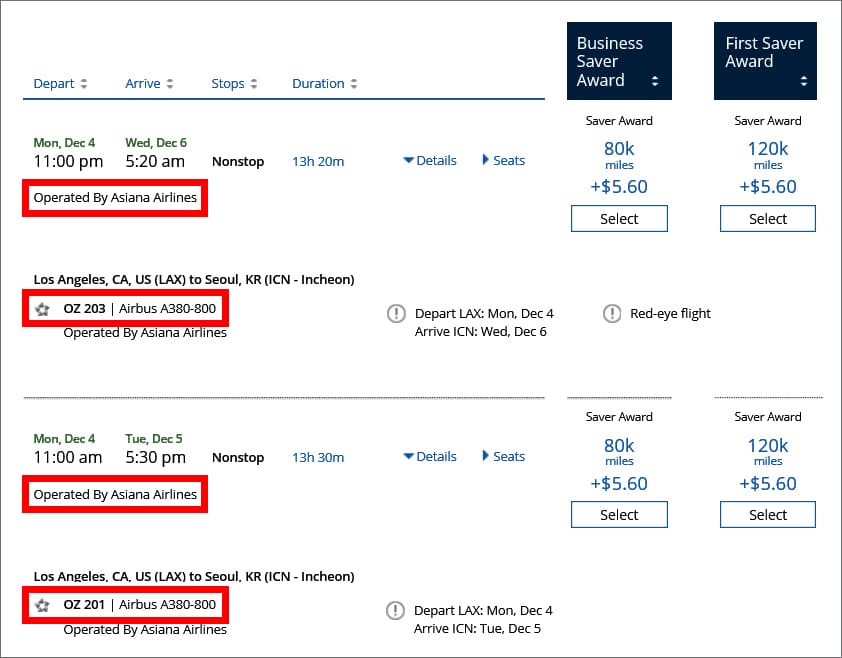
So, if you have stacks of United miles, for example, you can use them to fly Asiana because both airlines are Star Alliance members. By the way, Asiana often has good availability in First Class, even if you're using partner miles (United—see screenshot below—and All Nippon). Although United will charge you a premium—meaning more miles than Asiana—but on the upside, the carrier offers you a free connecting flight from anywhere in the continental U.S. or Canada.
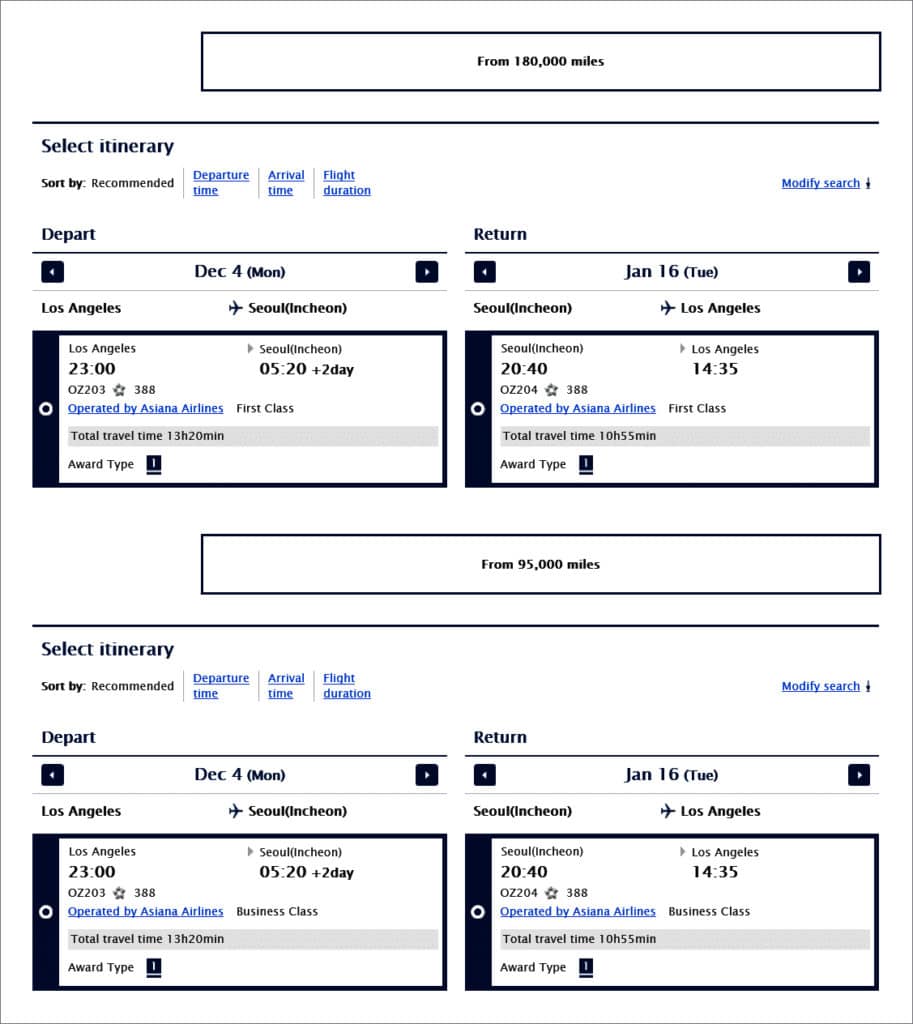
If you have Amex Rewards points, transfer them to All Nippon (see screenshot below), as Asiana is not an Amex point-transfer partner, then use them to book Asiana, as both are Star Alliance members.
Operating Airline Miles: Free & Paid Award Connections to Asia (From North America: Canada & Continental USA, Including Alaska)
[table_opt id="5936" style="gray-header" width="wide" alignment="thcenter" heading="thcenter" rows="tdcenter" responsive="no" /]
Using Partner Miles: Free & Paid Award Connections to Asia (From North America: Canada & Continental USA, Including Alaska)
[table_opt id="5934" style="gray-header" width="wide" alignment="thcenter" heading="thcenter" rows="tdcenter" responsive="no" /]
Make sense? Please provide feedback below; we're listening!
How to use FCF’s New Connection Widget to Snag a Deal to Asia.
Last month, FCF released its new “Sweet Redeem (SR)” widget for travel to Europe. It highlights mileage programs that offer a free add-on connection in the U.S. and Europe, so even if your departure city isn’t mentioned in a Newsroom Alert headline, you can still often get the mileage award, with the help of the Sweet Redeem Widget. For details go here.
Now we’re telling you how to use the Sweet Redeem Widget for travel to Asia.
In general, the Asia widget is like the Europe one: Scour the FCF Newsroom for a deal on the long-haul route, then use the Widget to get an idea of the connecting flights that can potentially be made to/from the gateway/s.
However, when it comes to the details, the story changes. Add-on connections are not always free to Asia, and two mileage programs, even ones that use the same type of award chart, may differ greatly in their offerings on a given route.
That’s mainly because, unlike Europe (one zone), Asia is so big that the carriers have divided it into a number of regions or...