
And How to Avoid Them...
[aside headline="Basis of Comparison" alignment="alignright" width="half" headline_size="default"]For “concept demonstrations purposes only”, we used real live “example data” for one route and date: New York-London, departing Jan. 15 with a Jan. 28, 2013 return. [/aside]
Fifty-four airlines in three major alliances, some with up to four cabin classes, and as many as seven types of mileage awards: Does anyone have the time to navigate this upgrade matrix? Raise your hand.
Nobody? That’s what I thought. And I don’t blame you for feeling diffident. I often do, too. That’s why this month, I’m launching a series of articles that will look at the most common upgrade pitfalls, by airline and destination.
In this issue, I’m putting the spotlight on American Airlines (Delta and United up next), a member of oneworld, and high-lighting the 11 most common mileage upgrade mistakes you can make when booking American’s Business and First Class to Europe. (E-mail me at mr.upgrade@firstclassflyer.com by Oct. 8 and tell me what airline and region I should analyze next.)
Misconception #1: American’s “cash surcharge” on mileage upgrades to Business Class makes the ticket a bad deal.
The surcharge keeps many travelers from upgrading. They typically think using miles for a free award ticket in Business Class is a better deal. In most cases, this is not true on Euro-pean routes, especially during shoulder- and off-season. As you can see from the chart at top right, an upgrade to Business Class often costs less than a free Business Class award ticket.
Cost of Business Class Upgrade vs. Free Mileage Award
[table_opt style="gray-header" id="1402 " width="" alignment="center" responsive="all" heading="thcenter" rows="tdcenter"]
Misconception #2: The chance of getting a free Business Class award ticket is better than a Business Class upgrade.
On most routes American releases more mileage upgrades than it does free mileage tickets. As for our sample route, my research shows that using miles for an upgrade gives you up to 67% more mileage seat inventory.
Availability of Business Class Upgrades vs. Free Mileage Award
[table_opt style="gray-header" id="1403 " width="" alignment="center" responsive="all" heading="thcenter" rows="tdcenter"]
While you may not need 15 tickets, this is just representative of how generous AA is with upgrade mile-age redemption allocation, com-pared to free seats. (AA generates more revenue out of the deal.) In other words, when there is no free award ticket availability, there often will be upgrade seats to be had.
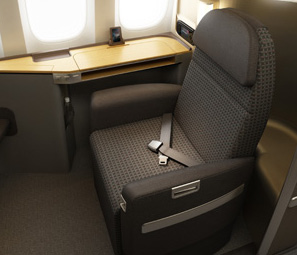
Misconception #3: The chance of getting a free Business Class award ticket is better than getting a free First Class ticket.
Conventional wisdom would suggest: Given that Busi-ness Class cabins on AA B777’s are larger and offer more seats—37 in Business Class versus 16 in First Class—your odds of scoring a Business Class seat should be higher, one would think. But that’s not always true. My experience shows that free mileage seat inventory for First Class is better than free inventory for Business Class. In fact, there are up to 480% more free First Class seats than Business Class dur-ing the travel window used for this real example.
Availability of Free Mileage Awards: Business vs. First Class
[table_opt style="gray-header" id="1404 " width="" alignment="center" responsive="all" heading="thcenter" rows="tdcenter"]
Misconception #4: Using American miles for a free Business Class award ticket is a good buy.
One of the biggest mistakes people make is to use miles for a Business Class award ticket. I suggest you use miles for First Class awards, because the return on miles is significantly higher, yet the cost is only 25% more. Plus your odds for mileage availability can be a lot better as the chart above shows, and the difference in comfort is night and day.
Misconception #5: American offers more free mileage award seats than its partners do.
Not true by a long shot. American’s major partner on New York-London, British Airways, has eight daily flights. That represents a huge increase in free mileage award seats. Moreover, British Airways gives AAdvantage members the same access to free mileage inventory that it does to its own members it seems. That means if BA has six award seats on a flight, then AAdvantage members can get them also. Add to that the fact that BA often has very good mileage seat availability, and your odds of scoring free mile-age space increases significantly.
Free Business Class Mileage Availability: American vs. British Airways
[table_opt style="gray-header" id="1405 " width="" alignment="center" responsive="all" heading="thcenter" rows="tdcenter"]
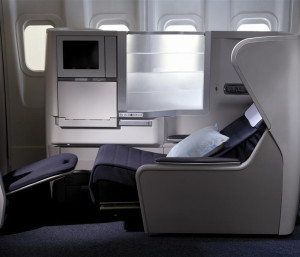
Misconception #6: American has a competitive Business Class seat to Europe.
Most airlines are almost finished rolling out flat-bed seats in Business Class on routes to Europe. AA hasn’t even started. Its Business Class seat is one of the worst in the air over the Atlantic. That’s why you should look to AA’s oneworld partners, British Airways and Iberia, both of which offer a seat that reclines 180 degrees, if you must fly Business Class.
Misconception #7: Earning AA Elite Qualifying Miles (EQMs) isn’t a must.
Wrong, wrong, wrong. You want to get EQMs every time you can if you are an elite-status flyer. And here’s a great strategy on New York-London: Upgrade from Premium Economy to Business on British Airways. You’ll earn EQMs, there’s no co-pay, and the cost is only 20,000 to 25,000 miles round-trip from the continental U.S.— up to 60% fewer miles than AA.
Here is the upgrade math: 20,000 BA miles cost $575, plus $1,363 (Premium Economy inclusive ticket cost) for a total of $1,938. The value of the miles earned back for the flight in Premium Economy is $209 and the EQMS earned come to 10,374, bringing the net cost of the ticket to $1,729. (You’re also 40% of the way to elite status.)
Here are two “general rules”:
- If you must earn AA miles, upgrade on BA from Premium Economy (PE) to Business.
- If you’re not an elite-status flyer and can forego the EQMs, use miles for a free First Class ticket.
Cost of Business Class Upgrade with British Airways vs. Free Mileage Award with American
[table_opt style="gray-header" id="1406 " width="" alignment="center" responsive="all" heading="thcenter" rows="tdcenter"]
Misconception #8: It takes time to get British Airways miles to work the system.
No, anyone can get them quickly, just by transferring them from one of the three major Multi-Airline Credit Cards (MACs; see article in FCF’s August issue, page 3), or BA’s own card.
- Amex Rewards: Look for BA transfer promotions throughout the year, such as the recent 40% transfer bonus; and if you do not have one now, get the Business Gold Rewards Card, which is currently offering 50,000 bonus points—enough for two free transatlantic upgrades on BA, which will earn you AA miles— after you spend $5,000.
- Chase Sapphire: Offers 40,000 bonus points (after you spend $3,000 within three months) enough for two free transatlantic upgrades on BA from some U.S. departure cities, which will earn you AA miles.
- Amex Starwood: This card offers a 25% transfer bonus on every 20,000 miles transferred. (Up to 25,000 bonus points for new accounts; 10,000 points after the first purchase and another 15,000 points when you spend $5,000 within six months—enough for one free transatlantic upgrade on BA, which will earn you AA miles.)
- BA Visa Card: Gives you 50,000 bonus miles after you spend $1,000 within 90 days—enough for two free transatlantic upgrades on BA, which will earn you AA miles— and at times, some one-off promotions yield 100,000 miles.
[aside headline="Miscellaneous Items to Keep in Mind" alignment="alignright" width="half" headline_size="default"]
With BA points: The lowest mileage cost is to London. If you’re flying beyond London, fly economy class since BA’s Business Class on intra-European flights is usually an economy seat with the middle seat open.
From the West Coast: If your departure city is Los Angeles or San Francisco and there are no award or upgrade seats available, look into making a connection in another BA gateway. There are 15 of them, including Atlanta, Boston, Chicago, Dallas, Houston, Las Vegas, Miami, Philadelphia, and Washington, DC.
Book the domestic leg in coach if domestic First Class is not available on AA, and stand-by for the upgrade, if cash-savings is your driver. The focus should be getting the trans-Atlantic por-tion confirmed up front. No one has to know you took a flight in coach for the domestic portion![/aside]
Misconception #9: AAdvantage members should carry an AA branded credit card.
No, unless you need it to earn EQMs. If so, AA World Elite Mastercard offers 10,000 EQMs once you spend $40,000. Otherwise get a Starwood card, which gives you the option to transfer miles to both AA and BA, plus a 25% bonus for every 20,000 points transferred. (Perhaps after you signed up for the other cards for the bonuses.)
Misconception #10: Look to American first for a free Business Class award ticket.
Nope, look at British Airways. The cost from East Coast and Midwest cities, 80,000 miles, is a great buy, especially if you add in the 25% bonus via Starwood, which brings the cost down to 65,000 miles. Granted, the taxes and fees for award tickets are higher on BA (as much as $800 more than AA).
Weigh that against much better award space availability, fewer miles burned (the 20,000 fewer miles could be valued at $575), and a much better seat. Your call.
Misconception #11: It’s always worth using miles to get a First Class upgrade or free award.
No again. When First Class goes on sale, for example the current holiday (Thanksgiving and Christmas) fares to Europe, pay cash. Neither an upgrade nor an award ticket yields a good return on miles. (See FCF’s August issue, page 1, for details.)
And How to Avoid Them...
[aside headline="Basis of Comparison" alignment="alignright" width="half" headline_size="default"]For “concept demonstrations purposes only”, we used real live “example data” for one route and date: New York-London, departing Jan. 15 with a Jan. 28, 2013 return. [/aside]
Fifty-four airlines in three major alliances, some with up to four cabin classes, and as many as seven types of mileage awards: Does anyone have the time to navigate this upgrade matrix? Raise your hand.
Nobody? That’s what I thought. And I don’t blame you for feeling diffident. I often do, too. That’s why this month, I’m launching a series of articles that will look at the most common upgrade pitfalls, by airline and destination.
In this issue, I’m putting the spotlight on American Airlines (Delta and United up next), a member of oneworld, and high-lighting the 11 most common mileage upgrade mistakes you can make when booking American’s Business and First Class to Europe. (E-mail me at mr.upgrade@firstclassflyer.com by Oct. 8 and tell me what airline and region I should analyze next.)
Misconception #1: American’s “cash surcharge” on mileage upgrades to Business Class makes the ticket a bad deal.
The surcharge keeps many travelers from upgrading. They typically...