
… and How Anyone Can Enjoy the Spoils.
Upgradeable fares are a lot like advanced physics: Things don’t often make much sense to ordinary people. Can the universe really be held together by something called “Dark Matter” and rest on a particle called the “Higgs Boson?” And why is it that buying the “lowest upgradeable fare” is
to score an international Business Class seat?
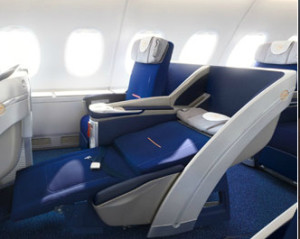
You’ll have to be on the edge of your seat as far as the first question, but as for the second, we can explain why going for the lowest upgradeable fare can, at
times, cost you more money, more miles, a better seat, a better flight schedule, and result in earning fewer award and Elite Qualifying miles (EQMs).
And why—and yes, it is counter intui-tive, but bear with us—the better choice is going for the full-price economy fare known in airline par-lance as the B-fare. We’ve dubbed this approach to using miles to upgrade the “B-Fare Comparison” or “BFC Tactic.” Here’s how it works.
First, you need to know two fare terms:
- B-fare Upgrade Awards: There are two upgradeable full-economy class fares, Y and B. Y is always full priced. B is sometimes discounted, but not nearly as much as the lowest economy class fares; it also is not subject to exorbitant co-pay premiums.
- Alliance Upgrade Awards: An upgrade on an airline’s alliance partner using a separate award chart. For example, using United or US Airways miles to upgrade an economy ticket on Singapore Airlines. Alliance upgrades almost always require purchasing a Y or B fare.
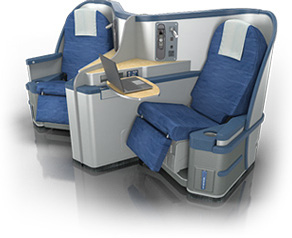
Best Alliance to Exploit the BFC Tactic
Hands down, the Star Alliance—Lufthansa, Scandinavian, Singapore, SWISS, United, and US Airways—takes the gold for travel to Europe, because on many routes these carriers offer low B-fares, and the upgrade is allowed on all Star Alli-ance partners.
On the other hand, avoid American and Delta because full-fare upgrades are often priced high and their partner options are limited.
Breakdown 8: Eight Reasons to Use the BFC Tactic the Next Time You Use Miles to Upgrade
1: You can avoid co-pay premiums with BFC: As you can see below, the co-pay on the lowest upgradeable fare can make it more expensive than a B-fare upgrade award.
Avoid the Co-pay Premiums With BFC*: Tactic Illustration
[table_opt style="gray-header" id="1055 " width="" alignment="center" responsive="all" heading="thcenter" rows="tdcenter"]
More Tactic Illustration Sample Routes*
[table_opt style="gray-header" id="1057 " width="" alignment="center" responsive="all" heading="thcenter" rows="tdcenter"]
2: Fewer award miles are needed for an upgrade with BFC: The lowest upgrade through US Airways’ own mile-age program costs 60,000 miles. Book the Star Alliance upgrade and you save 10,000 miles. That might not sound like much, but after five upgrades your sixth is free.
Save Miles With BFC Betweeen the US & Europe
[table_opt style="gray-header" id="1060 " width="" alignment="center" responsive="all" heading="thcenter" rows="tdcenter"]
[aside headline="" alignment="alignright" width="half" headline_size="default"]
The Hunt for the Best B-Fare Routes
Locating B-fares for the BFC mileage upgrade tactic
Okay, here’s the downside. The B-fare is so good that most airlines (except two, Delta and United) make you call to get it (or you can go through a travel agent). Delta and United offer a search option on their booking screen. Try different route combinations to find anomalies.[/aside]
3: More partner upgrade opportunities with BFC: Because B-fares qualify for the Star Alliance upgrade, you have “a lot more reach” for travel to Europe. For example, if you have miles with United, the Alliance upgrade gives you ac-cess to upgrade inventory on 12 other airlines: Air Canada, Air New Zealand, Austrian Airlines, Brussels Airlines, LOT Polish Airlines, Lufthansa, Scandinavian Airlines, Singapore, SWISS, TAP Portugal, Turkish Airlines, and US Airways. More comfort options the better.
4: Earn elite status faster with BFC: Most discounted econ-omy fares only earn 100% Elite Qualifying Miles (EQMs) at best. When you buy a higher fare, you can often earn as much as 50% more EQMs. After just two trips to Europe on a B-fare, you could have enough EQMs to earn entry-level elite status or move up to the next elite tier.
Earn More Elite Qualifying Miles with BFC
[table_opt style="gray-header" id="1062 " width="" alignment="center" responsive="all" heading="thcenter" rows="tdcenter"]
5: Earn award miles faster with BFC: Most discounted economy fares only earn 100% award miles, but often B-fares earn 125%. On United’s Dallas-Rome route, the B-fare nets about 14,000 award miles, making the net upgrade cost only 26,000 miles. A better way to think about net cost.
Earn More Award Miles (Save More $) with BFC
[table_opt style="gray-header" id="1065 " width="" alignment="center" responsive="all" heading="thcenter" rows="tdcenter"]
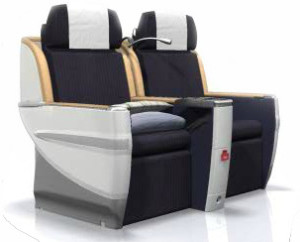
6: Travel on a better flight schedule with BFC: Take advantage of an “alliance upgrade” and fly on partner airlines for better flight schedules. For example, on Chicago-Stockholm route, United requires a connection in Newark, but Scandinavian Airlines flies non-stop.
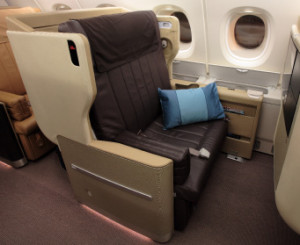
7: Enjoy a better Business Class seat with BFC: On the New York-Frankfurt route, Singapore and United offer non-stop service. I don’t know about you, but I would rather sit in Business Class on Singapore’s A380—the widest (34”) and some would even say, the best seat in the sky—than the alternatives.
8: Save up to 43% on taxes with BFC: Who doesn’t hate paying airline taxes and fees, especially when they can be as high as $1,100 to Europe. One way to save up to 44% is by upgrading a low B-fare. On United’s Dallas-London route, taxes on a Business Class ticket are about $1,169; taxes on a B-fare are $665, a difference of $504 (43%).
… and How Anyone Can Enjoy the Spoils.
Upgradeable fares are a lot like advanced physics: Things don’t often make much sense to ordinary people. Can the universe really be held together by something called “Dark Matter” and rest on a particle called the “Higgs Boson?” And why is it that buying the “lowest upgradeable fare” is
to score an international Business Class seat?
You’ll have to be on the edge of your seat as far as the first question, but as for the second, we can explain why going for the lowest upgradeable fare can, at
times, cost you more money, more miles, a better seat, a better flight schedule, and result in earning fewer award and Elite Qualifying miles (EQMs).
And why—and yes, it is counter intui-tive, but bear with us—the better choice is going for the full-price economy fare known in airline par-lance as the B-fare. We’ve dubbed this approach to using miles to upgrade the “B-Fare Comparison” or “BFC Tactic.” Here’s how it works.
First, you need...