
- Escape the perils of United’s recent MileagePlus devaluation.
- Pay half of what your friends and family pay for premium class travel.
- Take advantage of almost unbelievable award chart discrepancies.
- Learn why it’s important to use the right Upgrade Mindset credit cards.
- Get two tickets for less than the price of one.
Many travelers—frequent and non-frequent, savvy and novice alike—make the same mistake: They search countless sites for the perfect fare. The return on their time is often modest at best.
The alternative I propose today is called the Upgrade Mindset (UM), and it only requires two things:
- Carry the right credit card(s).
- Stay open-minded about booking on new sites and enrolling in new loyalty programs (because you can leverage both with the right credit cards).
The Cart-Horse Problem
Most people put the cart before the horse, which means they focus on credit cards that offer big mileage bonus deals (not always a bad idea), even though they haven’t thought through how and where they are going to use the miles those cards offer. What you want is the horse—the set of upgrade tools that will enable you to load up your cart. The horse is the unbelievable award chart discrepancies out there that are easy to land if you have the right credit card.
Rule #1: Carry the Right Credit Card
Don’t use co-branded cards marketed by your preferred airline, such as United’s MileagePlus Visa, for everyday spending, because it restricts you to earning currency in only one loyalty program. It’s fine to have a Chase Ultimate Rewards card as a back-up for Amex, but not fine to use a Delta-centric card because you’ll just build up a huge SkyMiles balance. That’s a disadvantage because seats are seldom available on Delta, the program changes often (not for the better), and the miles can only be used on Delta and its partners.
The best way to play your cards is holding a hand that earns points (miles) in the card issuer’s own (or partner) currency, such as an American Express Starwood Preferred Guest Card—which has 32 transfer partners—and American Express Membership Rewards—which has 17 transfer partners.
The rule of thumb here: The less flexible you are, the better Membership Rewards is, as transfer times can be almost instantaneous and are often same-day. The more flexible you are, the better is Starwood’s Starpoints, given the longer transfer times, as availability can change, especially on an airline that won’t hold space.
Rule #2: Be Open-minded About Booking on New Sites Through Different Loyalty Programs
By having the right credit card you will have access to 17 to 32 mileage programs (carry and focus on both cards like I do, and the number jumps to 37) which offer:
- A way to escape program devaluations: All your eggs aren’t in one basket.
- Access to lucrative discrepancies: Multiple baskets to cherry-pick.
- Full Potential: You don’t have to accept whatever your airline program offers.
The Alternative Mindset
When I travel, I begin with:
- Which airline has the best schedule and/or best seats.
- Who are its partners, both airline and Multi-Currency Partners.
Now I know how to go about getting the schedule and/or seat that most suits the trip.
Start with the best seats and/or schedules, then work backwards from there into Membership Rewards or Starpoints. Think about the number of options you can have, as you will often need them when booking award travel. With the 37 partners the two Amex cards offer, we’re talking most major carriers. This is how to continue the process.
Seize the Discrepancies Between Top Loyalty Programs
In the world of free mileage award travel, there is a fundamental divide in how airlines calculate the miles charged: Some carriers use a Zone Chart, others a Flight Distance Chart.
Zone Charts: A zone chart, most common among U.S. Airlines, divides the world into regions (e.g., the 48 contiguous states and Canada), with every route between two different zones costing the same number of miles.
Flight Distance Charts: A flight-distance chart is simpler in some ways: the distance between departure and arrival cities determines the miles required for a free award ticket. Asian carriers tend to gravitate to the flight distance system, and British Airways does as well.
Now You’re Ready for Free and Low-Cost Upgrades:
This Month Star Alliance to Europe is Under the Microscope
Let’s take Business Class Chicago-Frankfurt on United as an example. Charlie—a Chase Ultimate Rewards member—pays United 115,000 miles round-trip for a free Business Class award ticket on United flights. But Sam—a Starwood and Amex Rewards card holder—redeems miles for the same United flight using All Nippon Mileage Club miles (a points transfer partner of both cards) and pays only 68,000 miles round-trip—41% less than United charges Charlie.
That 47,000-mile reduction is the equivalent of an “almost free upgrade,” since United charges 60,000 miles for a free economy award ticket.
But you want a free upgrade, don’t you? Well, the Almost Free Upgrade (AFU) above turns into a Less than Free Upgrade (LFU) if you use Starwood Starpoints, given the 25% bonus you get for every 20,000 transferred.
In other words, while Chase Charlie transfers 60,000 Ultimate Rewards points to get a free economy ticket, Starwood Sam transfers 60,000 points to get Business Class. And Sam has 7,000 points remaining, so he paid less than Charlie, hence the LFU.
[aside headline="For FCF Subscribers Who Live Abroad (or in U.S. Cities Not in the Examples)" alignment="alignright" width="half" headline_size="default"]The article has global relevance because almost anyone can get access to All Nippon miles via a credit card transfer, book All Nippon’s mileage partners, and save on First and Business Class travel. For example, All Nippon’s United mileage award is offered from Europe to North America. Air Canada’s flight awards are offered from Europe to Canada, Lufthansa’s flight awards are also offered from Asia to Europe.[/aside]
Working the System Mindset: First Class
If Chase Charlie transfers points to United miles for a First Class award, he loses even more. Staying with the same route (Chicago-Frankfurt), but in First Class, Starwood Sam (or Amex Rewards Ron) uses All Nippon, which costs 100,000 miles round-trip, 15,000 miles less than United charges for Business Class (115,000) on its own flights. That’s what Charlie is paying. Can you say, “Less than Free Upgrade?”
Plus, Charlie transfers 115,000 Chase points to get a free Business ticket; Sam transfers 80,000 Starpoints to get First Class. So Sam pays less than Charlie and gets a free upgrade.
Working the System Mindset: How to Get Two Tickets for Less than the Price of One
Chicago-Frankfurt, flying with Lufthansa in Business Class using United miles costs 140,000 miles round-trip.
But All Nippon charges only 68,000 miles round-trip for partner awards. So the cost for two Business Class tickets on Lufthansa is 136,000 miles with All Nippon. So Charlie pays 4,000 more miles for one ticket, than Sam does for two.
You Have this Strategy Nailed, But You’re Not Going to Europe on a Star Alliance Carrier
We just gave you some fresh fish, but half of you will want to learn to fish for yourself; either way, I’m happy, just so long as they make their way to the dinner table.
Step One: Get a sense of flight schedules and the flight distances for each airline and route. That’s most easily done on a website such as ITA Software. Taking Chicago-Frankfurt and using ITA, we found that two major airlines fly daily nonstops, Lufthansa and United. Upon clicking “United,” a gray box appears to the right of the screen quoting the mileage distance: 8,658 round-trips.
Step two: Determine what a flight distance partner-award would cost with All Nippon miles (or the program at hand). Flights between 7,001 and 9,000 miles round-trip are 68,000 in Business Class and 100,000 in First Class; between 9,001 and 11,000 miles Business Class is 85,000 miles and First Class is 120,000 miles. Flights up to 14,000 miles are 90,000 in Business Class and 140,000 in First Class (see All Nippon screenshot below). For flights over 18,000 miles a zone chart is usually a better deal.
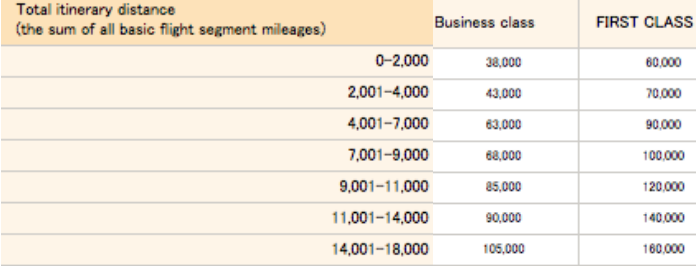
Step three: Determine what a zone award would cost with United miles (or the program at hand). Europe in Business Class is 115,000 round-trip and First Class is 160,000 on United flights. Partner flights to Europe on airlines such as Lufthansa and SWISS are 140,000 in Business Class and 220,000 in First Class. (See chart below.)
Step four: Compare mileage cost. See the chart below for sample routes.
- Escape the perils of United’s recent MileagePlus devaluation.
- Pay half of what your friends and family pay for premium class travel.
- Take advantage of almost unbelievable award chart discrepancies.
- Learn why it’s important to use the right Upgrade Mindset credit cards.
- Get two tickets for less than the price of one.
Many travelers—frequent and non-frequent, savvy and novice alike—make the same mistake: They search countless sites for the perfect fare. The return on their time is often modest at best.
The alternative I propose today is called the Upgrade Mindset (UM), and it only requires two things:
The Tale of Two Travelers: Chase Charlie and Starwood Sam— Chicago-Frankfurt, Business Class
- Carry the right credit card(s).
- Stay open-minded about booking on new sites and enrolling in new loyalty programs (because you can leverage both with the right credit cards).
The Cart-Horse Problem
Most people put the cart before the horse, which means they focus on credit cards that offer big mileage bonus deals (not always a bad idea), even though they haven’t thought through how and where they are...