
You’ll flip: Why outbound and return flights are not two sides of the same coin and how you 'might' save miles when booking them separately on American, Delta, and United.
Most travelers don't have as many miles as they’d like. But when they go to book an award flight, they’ll typically select “Business Class” or “First Class” and “round-trip.” And what does that get them? Either prices that they can’t afford or prices that are higher than they’d want to pay (even if they have the miles).
Few airlines, however, allow you to select one class of service for the departure flight and a different class of service for the return flight in order to get a lower overall price.
Very few people think of searching and booking one way to save miles. But that’s what I usually do for a myriad of reasons, and you should consider doing it too — with a few exceptions which we will discuss below.
Plus, most people forget that the outbound overnight flight to Europe is much more important than the return day flight, and should be budgeted for accordingly. Given these dynamics, the likelihood of booking the best possible trip is barely 1% if you don’t plan strategically.
Mixed-Cabin Miles Think
We recently did a series of special reports on this topic, when using normal published fares, here, here, and here to prompt you to think creatively about mixing up your seats. You have more choice than you think. You can mix up your cabins, your carriers, and your connections to maximize the value of your investment. Default thinking has most people accepting exactly what the airline dishes up. But you can have much more control over your destiny.
My Flight Formula: A to B ≠ B to A
or
Cabin Mixing, the Lunch Versus Dinner Perspective
Most people budget more for dinner than they do for lunch. For example, you might allocate $10 or $20 for lunch and $30 or much more for dinner. Yet they’re both meals, right? Similarly, are you thinking about your round-trip ticket as two separate things that have different levels of importance? Or are you treating them the same and allocating your budget evenly?
Put in airline terms, if I’m flying overnight to Europe, I would pay more for a great (if that can be said) night flight and pay less for the return day flight. That’s because the day flight is where I’m on my laptop or reading or listening to an audiobook. But on the overnight flight, sleep — and the quality of it — has a critical impact on my mental performance upon arrival and helps minimize the jet lag issues that aren’t as harsh on the return day flight.
One Example
If I’m going from New York to Athens (or any place in the area that requires a connection) I’d fly First Class on Emirates outbound and shift my dates around to get that flight because I hate night flights and try to avoid Business Class if I can. But I wouldn’t change my date (necessarily) to get a round-trip flight in First Class when I don’t absolutely need it for the return. Instead, I might fly Business Class on the return if I was short on miles or points or if the schedule was much better. Many would be content with Premium Economy based on savings that we examined last month.

Let’s take a look at the good, the not great, and the ugly of how the big three U.S. carriers enable the mixed-cabin booking strategy with miles.
Good:
United Mixed-Cabin Awards
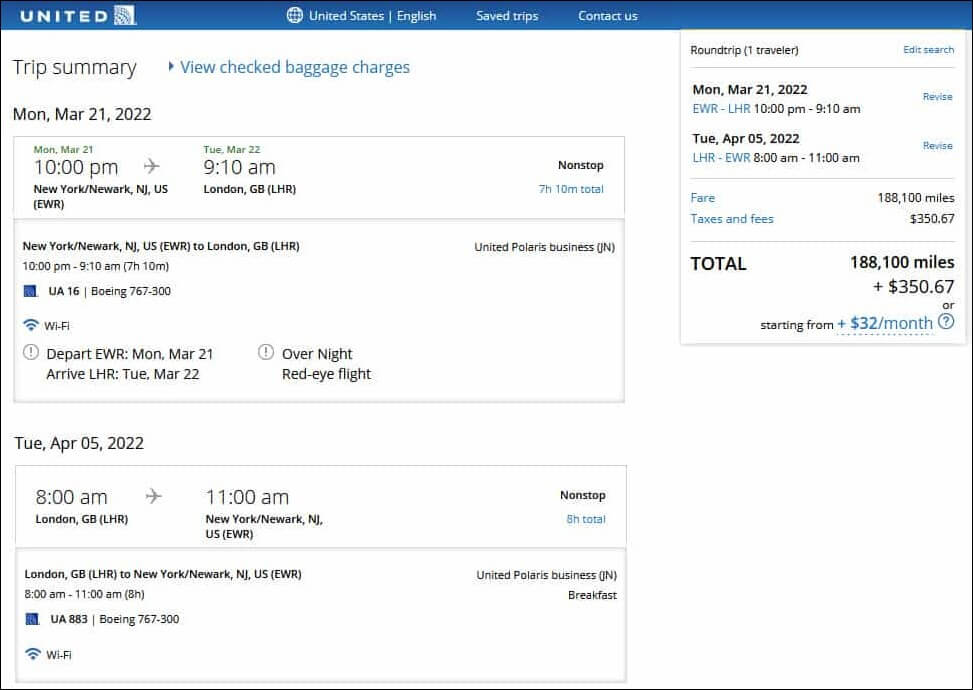
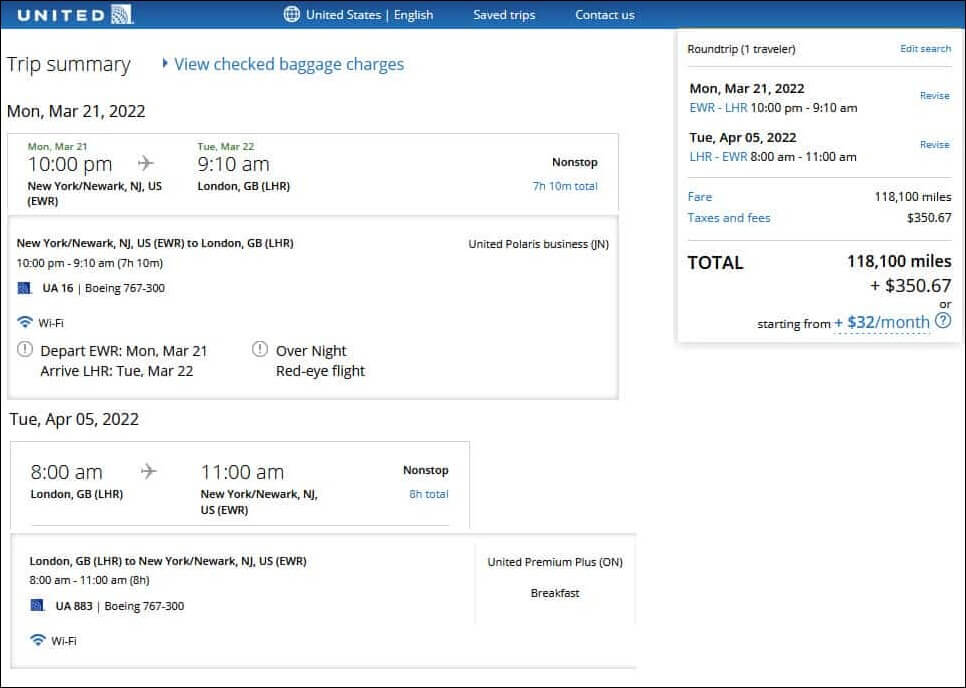
The screenshots below show the cost of flying out and back in Business Class (188,100 miles) versus flying out in Business Class and back in Premium Economy (118,100 miles), plus $350 in taxes for both options. So you’re saving 70,000 miles on a flight you may not need to pay so much more for. The difference really adds up if you’re a family of four and saving 280,000 miles. Take a look:
United Business Class Round-Trip Example
New York-London 188,000 Miles
United Business Class Outbound / Premium Economy Return Example
New York-London 118,000 Miles
Not Great:
American Mixed-Cabin Awards
You can’t play the mixed-cabin miles game with American miles to Europe as well because when you book a mixed-cabin trip on the same ticket, American prices it as two one-ways — and the airline inflates one-way pricing! So that yields savings of only about 10% to 20%. I'd never recommend downgrading for that small amount of savings, unless it was for the kids’ tickets and they hadn’t been doing their homework. A downgrade is only an upgrade when the savings are big.
Usually Ugly, Sometimes Okay:
Delta Mixed-Cabin Awards
Delta typically charges 340,000 miles round-trip to Europe, which I don't recommend under any circumstances.
But we found on its New York-London service, occasionally you can do a mixed-cabin trip; fly outbound in Business Class and return in Premium Economy for around 169,000 miles, which would be worth considering if you were flying with many people.
That doesn’t work on Delta’s New York-Frankfurt route, however, since round-trip Business Class is 210,000, Premium Economy is 203,000 round-trip, and mixed-cabin Business Class outbound and Premium Economy return is 230,000. Yes, that’s right – mixed-cabin is actually more than round-trip Business Class.
If you don’t have the miles or want to save them to get the highest Return on Investment, FCF suggests treating outbounds and returns like you do lunch and dinner.
Differently.
You’ll flip: Why outbound and return flights are not two sides of the same coin and how you 'might' save miles when booking them separately on American, Delta, and United.
Most travelers don't have as many miles as they’d like. But when they go to book an award flight, they’ll typically select “Business Class” or “First Class” and “round-trip.” And what does that get them? Either prices that they can’t afford or prices that are higher than they’d want to pay (even if they have the miles).
Few airlines, however, allow you to select one class of service for the departure flight and a different class of service for the return flight in order to get a lower overall price.
Very few people think of searching and booking one way to save miles. But that’s what I usually do for a myriad of reasons, and you should consider doing it too — with a few exceptions which we will discuss below.
Plus, most people forget that the outbound overnight flight to Europe is much more important than the return day flight, and should be budgeted for accordingly. Given these dynamics, the likelihood of booking the best possible trip is barely 1% if...