
Why you never really know what an option is – or what "better" costs – until you measure it against the next one.
Twenty-three hundred years ago, Aristotle opened his Nicomachean Ethics with a plain observation: Every human action aims at some good. Put in modern English, every move you make is an attempt at making something better.
Yet almost nobody stops to ask how better is actually measured.
In travel, better is not only having a ticket versus not having a ticket. Better is moving from a known starting point – your Baseline – to a superior Option. The difference is the yardstick that tells you how much superior better really is.
Without a comparison, a fare quote is just a number floating in space.
That brings us to the single habit behind this report: know your option. You do not know what an option is until you know how it contrasts, compares, and differs from another option. You are never just hunting for the lowest price – anyone with common sense would pay $10 more for a far better seat – because your real aim is quantifying the cost of better.
One Engine, Two Starting Doors
Before you can measure any difference, you need one anchor on the table. I call this the Five-Minute Baseline Rule. Spend five minutes – not 50 – grabbing one real starting fare so you know the terrain before you hand off the search.
Over 30 years of flying up front, I have noticed I enter this process through two different doors depending on the trip. Both doors look different on the surface, yet they feed the exact same comparison engine.
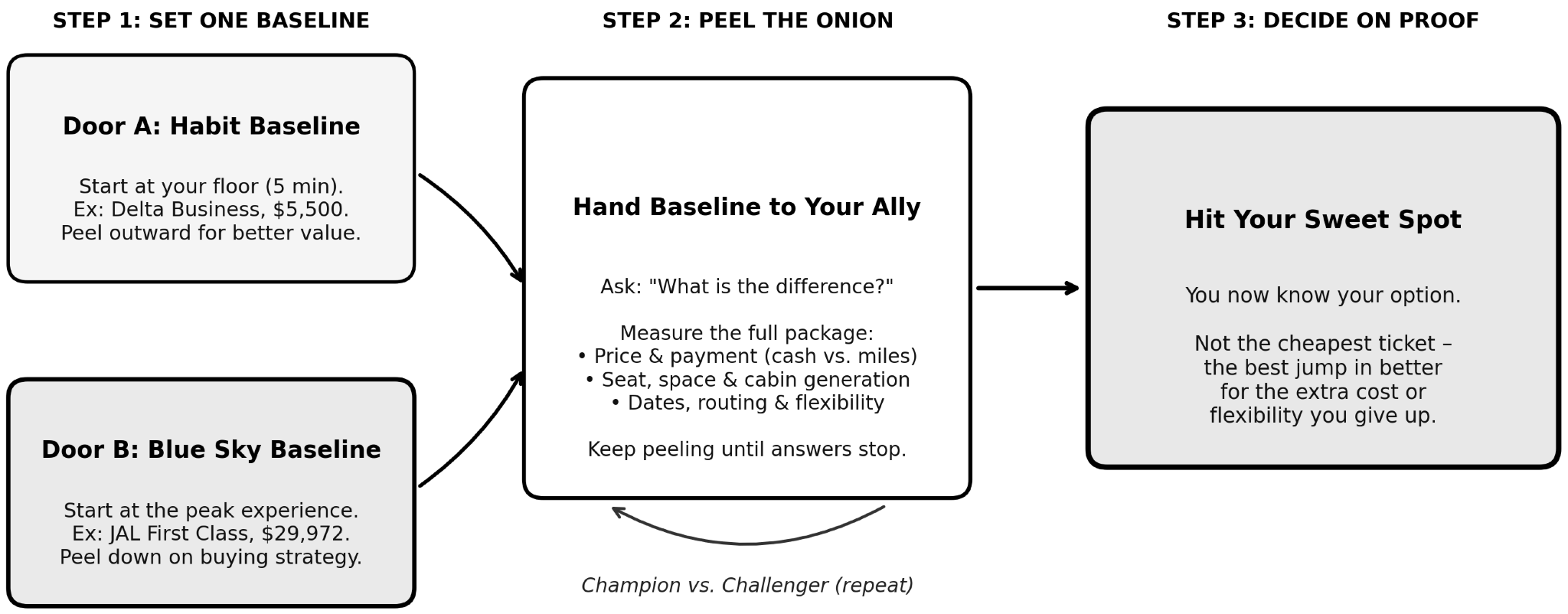
Door A – The Habit Baseline (Floor Up): Start at your usual floor – the airline or cabin you fly out of habit, such as Delta Business Class to Europe. Starting with your habit is not a mistake; it gives you a concrete Baseline. It only turns into a trap when you let your habit become the ceiling on your Desires and stop looking one gate over.
Door B – The Blue Sky Baseline (Peak Down): Start at the peak – naming the single best seat in the sky on that route, such as Japan Airlines First Class to Asia. You walk in assuming something far better exists out there, and finding it is simply a matter of turning over enough rocks. From that peak, you ask what changes when you alter how you buy it.
Notice how cleanly those two mindsets fit together. A Habit Baseline sets the floor you want to beat, while a Blue Sky Baseline removes the ceiling on what you believe is possible. Either way, the moment your first anchor hits the table, the real work begins: measuring the difference against everything else.
How I Know An Option
Two starting anchors, one comparison engine
Is this overkill for your travel life?
If so, I get it. Getting the best possible isn't always a priority. However, some relationships, some business moves, or health needs, require this kind of rigor.
Now you're armed for flights – or anything in life that comes at you.
Hand It to Your Ally – Not Your Adversary
Notice I did not tell you to spend your afternoon arguing with airline reservationists or travel agents. Leave that legwork to your own ally – your assistant, secretary, travel partner, or researcher – who interfaces with airlines and travel agents on your behalf.
Your job is to hand your ally a clean Baseline and the exact questions to improve on it.
This also solves a hesitation almost every sharp buyer feels. People hate revealing their best deal because they worry a salesman will use that number against them. That caution makes complete sense with an adversary – a commission-driven seller sitting across the table negotiating price against you.
An ally on your own team is the exact opposite. Hiding your Baseline from your assistant or trusted advisor is unproductive and wastes everyone's time, because they cannot find better if they do not know what they are trying to beat.
Aristotle would not be pleased.
Give your ally the anchor up front, and ask them to do the math on what changes when you alter the variables.
Most travelers stop after the first quote out of plain impatience. They hear one price, assume that is simply what the market charges, and pull out a credit card. My rule is simpler: keep peeling the onion until your advisor runs out of answers – or you run out of advisors.
Peeling the Onion: Two Ways to Run It
Once your Baseline sits on the table, do not drown yourself in 14 open browser tabs. Treat your best fare so far as the Champion, and force every new quote to step into the ring as a Challenger. Every Challenger gets measured against the Champion across the full package of differences – not just dollars, but seat quality, payment strategy, and schedule flexibility.
Example A (Habit Baseline – Floor Up):
New York to Milan
Suppose you need Business Class from New York to Milan and normally fly Delta. You take five minutes, pull a $5,500 Delta quote as your Baseline, and hand it to your assistant. Now you start peeling the onion with four words for everything they come back with: "What is the difference?"
First, peel the variables – airlines, dates, cabins, or paying with miles versus cash. Your ally comes back with United at $3,500 on the same route, which is $2,000 – or 36% – less than your Champion. Now United is in prime position, and you peel the second layer: "What is the difference in quality?" – comparing seat width, cabin age, space, routing, and any other preferences.
Then you peel a third layer where most travelers never look: "What is the difference between the new Business seat and the old Business seat on that exact aircraft?" One plane may carry an outdated recliner while a flight two hours later carries a modern lie-flat suite for the same money.
Schedule and aircraft discrepancies run rampant.
You keep asking "What is the difference?" until every real gap is exposed in black and white.
Example B (Blue Sky Baseline – Peak Down): U.S. to Asia in First Class
Now flip the entry door and start at the top. Say your Baseline for the finest seat in the sky on a route to Asia: Japan Airlines First Class, priced at $29,972 round-trip in cash. Most people look at a $30,000 quote, laugh, and walk away.
Instead, you hand that cash quote to your ally and ask: "That is the cash strategy – what is the difference in the overall package if I buy it using a different strategy, like miles?" Using purchased miles on sale, that exact same First Class cabin drops to roughly $4,305 round-trip. That is more than $25,000 saved for the identical seat.
Here is why you always measure the package of differences, never just the price tag. The difference is not only $25,000 in cash saved – it is also trading fixed dates for strategic flexibility, booking either 300+ days out or close to departure when award seats open. Once your ally lays both packages side by side, you actually know your option, and the decision takes 10 seconds.
Finding Your Sweet Spot
Whether you start at your habit floor or your Blue Sky peak, the finish line is identical. You are looking for your personal Sweet Spot – the point where a small extra cost or a modest shift in flexibility buys a massive jump in better. You are not trying to spend as little as possible, and you are not throwing money at tiny gains.
The Upgrade Sweet Spot
Compare what you give up against how much better you get.

Intuitively, you understand this already. However, your team members are not always consciously operating with these principles in mind.
And it's costing you.
Just like it costs me.
Use this special report to install the Upgrade Mindset in your team.
Notice that this chart does not care whether you fly on a strict budget or money is no object. A budget-minded traveler might step up $10 or $150 for a far better seat, while a blank-check flyer might move a trip by one day to save $25,000 or secure a newer First Class cabin.
Every budget has a Sweet Spot – you just cannot see it until differences are quantified.
Beyond the Cabin: Same Yardstick, Any Decision
Travel is simply the cleanest classroom for what we call Better Upgrading. Once you get used to diving much deeper into knowing an option by its package of differences, you start spotting blind spots everywhere else you make Decisions.
Most people take the menu that's handed to them. While others ask, "What do you have that’s not on the menu?"
Your Single Habit: Know Your Option
Before you book your next flight, refuse to accept any quote in isolation. Set one five-minute Baseline – either your usual floor or your Blue Sky peak (or both) – hand it to your ally, and keep asking "What is the difference?" until the full package is clear and no better Challenger remains.
In Part 2 next month, we will map out which exact questions to ask across the four phases of a trip – from early dreaming to optimizing after you book.
Food for thought: If an option only reveals its true value when measured against another option, what is one travel habit, business expense, or life choice you are still pricing in isolation right now – without ever asking what the real difference is between it and the options?
See you on the journey.
Why you never really know what an option is – or what "better" costs – until you measure it against the next one.
Twenty-three hundred years ago, Aristotle opened his Nicomachean Ethics with a plain observation: Every human action aims at some good. Put in modern English, every move you make is an attempt at making something better.
Yet almost nobody stops to ask how better is actually measured.
In travel, better is not only having a ticket versus not having a ticket. Better is moving from a known starting point – your Baseline – to a superior Option. The difference is the yardstick that tells you how much superior better really is.
Without a comparison, a fare quote is just a number floating in space.
That brings us to the single habit behind this report: know your option. You do not know what an option is until you know how it contrasts, compares, and differs from another option. You are never just hunting for the lowest price – anyone with common sense would pay $10 more for a far better seat – because your real aim is quantifying the cost of better.