
The First Class portfolio play. The 360-day window. The only intelligence that gets you there first.
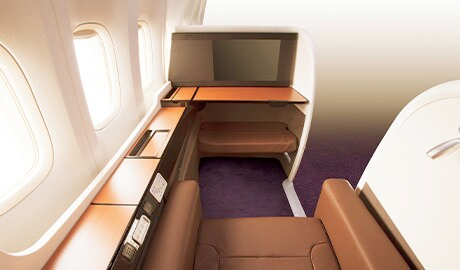
Sink into a 48-inch-wide private suite at 35,000 feet.
A 43-inch 4K screen. Cinema audio piped through the headrest. A personal wardrobe. A lie-flat bed. Six suites per plane. Fourteen hours to Tokyo.
The cash price? $29,972 round-trip.
Most people see that number, close the browser, and go back to booking Premium Economy. The upgrade thinker sees that number and sees something else entirely.
An opportunity. A problem worth solving.
An options portfolio waiting to be built.
Here is the truth that changes the entire game:
The $30,000 seat can be had for $5,252.
Less than Business Class.
Or 135,000 miles or points each way.
Easily.
The only variable is Upgrade Intelligence.
JAL First Class on B777
Your Baseline Is Not Your Ceiling
In the Upgrade Process, Step 1 is Baseline.
Your starting place. Where you are right now – honestly, clearly, without fantasy.
Most travelers stop here. They see $29,972. They accept it as the verdict. The Baseline becomes their ceiling.
Finding mileage award space is increasingly difficult these days.
It doesn’t even feel like an option anymore.
Most people have given up on miles and points saver awards.
The upgrade thinker uses these Baselines differently.
It's not the destination. It's the starting line.
The moment you understand that $29,972 is only the cash price – not the real price for those who know how to play – you've already moved past Step 1.
That's where the intelligence begins.
Desire Is the Data
Step 2 of the Upgrade Process is Desires.
You want the suite. The private sanctuary at altitude. The flat-bed sleep somewhere over the North Pacific.
An unforgettable experience.
One you will talk about for the rest of your life.
Say it out loud. Name the desire with precision.
In Upgrade Thinking, clarity of desire is not indulgence. It's navigation. You cannot see – or discover – Options without first knowing exactly what you desire.
The Japan Airlines First Class suite is the target.
Now let's build your Options Portfolio.
Position Before You Pursue: The Portfolio Play
Step 3 is Options. This is where most award travelers never arrive.
They quit at Baseline.
They have average desires.
They never get to Options. And they spend the rest of the year hearing about everyone’s amazing experiences.
The upgrade thinker thinks like an options trader.
In finance, an options contract gives you the right – not the obligation – to buy an asset at a fixed price.
You hold the position.
You exercise it when the time is right.
If circumstances shift, you walk away.
Award tickets work exactly the same way.
Book the seat nearly a year in advance.
Hold the position.
If your plans evolve, cancel it. Most programs let you redeposit your miles for minimal penalty.
You aren’t buying a ticket.
You are building a position.
Did I say that you can hold multiple options?
You can book and hold as many options as you have miles.
The early bird gets the suite.
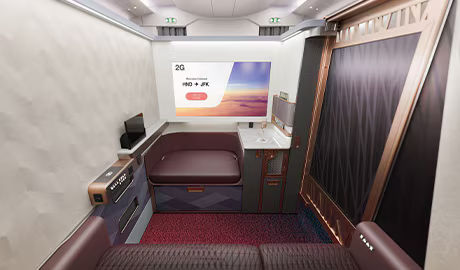
JAL First Class on A350
The 360-Day Window: Leverage Intelligence in Action
Japan Airlines releases its First Class award inventory to the Oneworld alliance up to 360 days before departure.
That is the starting gun. The programs with 360-day access – Cathay Pacific Asia Miles and Qantas Frequent Flyer – are at the absolute front of the line the instant it opens.
British Airways Avios? Day 355. Five days behind.
American Airlines and Alaska Airlines? Day 331.
Twenty-nine days late.
Twenty-nine days in this game is not a minor inconvenience. It is the difference between a private suite and a middle seat in Premium Economy.
By the time an American Airlines miles holder loads the search page, the First Class seat is gone. This is what the Upgrade Formula calls Leverage Intelligence – the strategic capacity to find the exact point where a small move produces a massive result.
The 360-day window is that point.
Set your alarm. Exactly 360 days before your target departure.
One exception: JAL occasionally releases unsold First Class inventory the day prior to departure up to 14 days out. If you are wildly flexible, American Airlines miles can work here. But for a specific seat on a specific flight, the 360-day window is your only intelligent play.
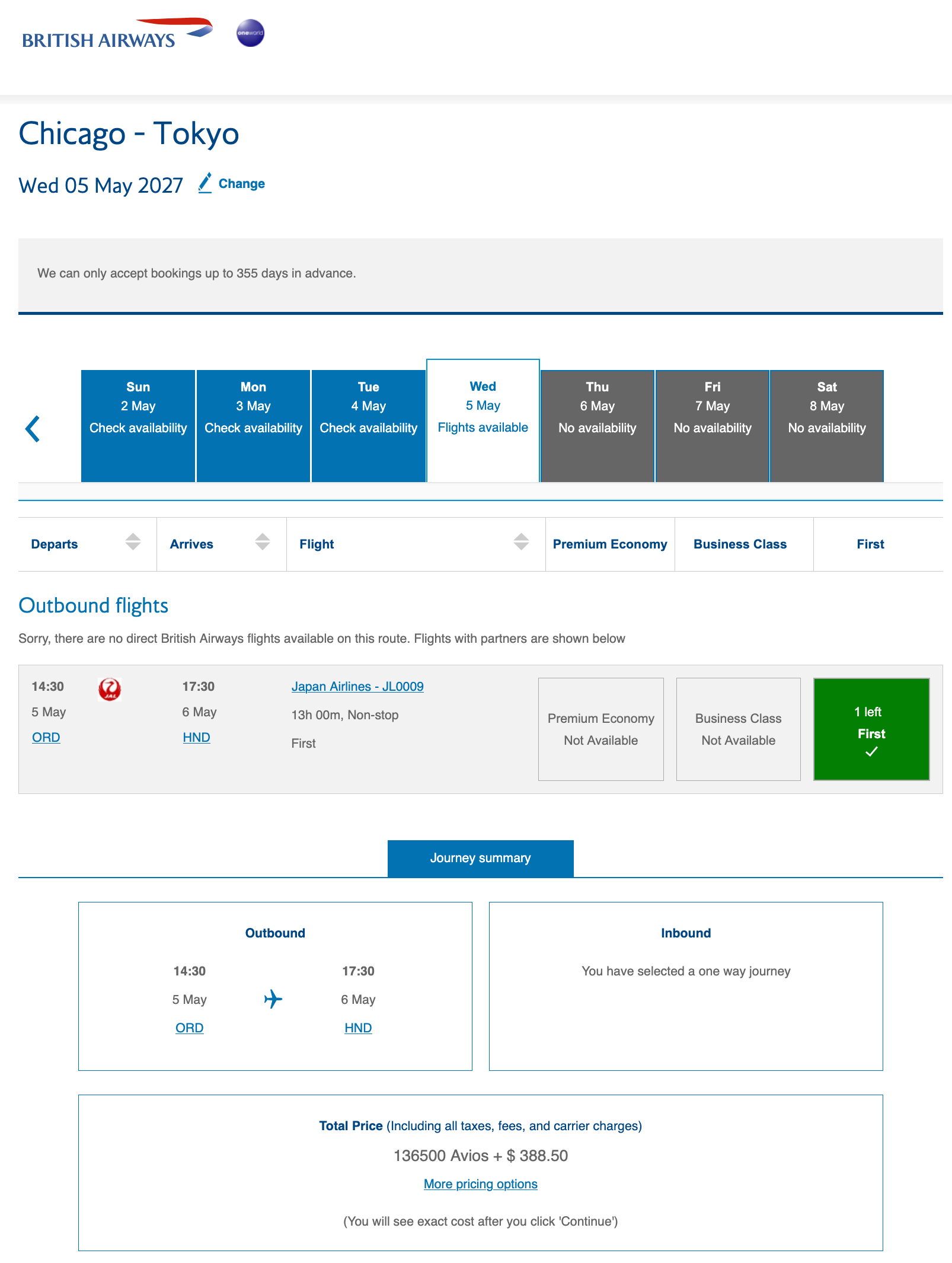
The Booking Window & Cost Comparison
To/From Asia
Example Availability Using JAL Miles from Chicago
125,000 Miles

Example Availability Using Cathay Miles from New York
135,000 Miles

Example Availability Using British Airways Miles from Chicago
136,500 Miles
No Miles? No Mystery. Just Method.
You don't need a stockpile. You need a Decision – Step 4 of the Upgrade Process.
Three clear plays, depending on your priorities:
The Pole Position Play. Transfer Amex Membership Rewards to Cathay Pacific. You get the 360-day window, the most powerful booking position available. The front of the line. The cost premium over American airlines and Alaska buys something priceless: first access to the seat.
The Patient Portfolio Play. Wait for a British Airways Avios sale or run a bonus promotion with Amex transfers, every two to three months and be able to book on Day 355. The 40% bonus is common with Amex and will slash the price.
You'll have less availability because you're behind people who have miles with Japan Airlines, Cathay Pacific, and Qantas on Day 360. You'll need to be a little more flexible with fewer available dates and seats.
The Pressing Play. Can't wait for the sale? Buy Amex points now and transfer immediately to British Airways or Cathay. Slightly higher cost. Faster execution. No missed windows.
Still saves $10,000+ each way.
Note: Qantas points are not available for direct purchase. Cathay Asia Miles are not for sale either – they are only accessible through transfers from Amex, Capital One, or Citi.
Know Your Exit Before You Enter the Position
Locking in award space nearly a year out – with full intention of canceling or changing if plans evolve – is one of the smartest moves in the upgrade thinker's playbook.
This is the options portfolio in its purest form: You hold a position you are not yet obligated to exercise.
But Reality Navigation – the Upgrade Formula's discipline of working with what actually exists, not the fantasy version – demands you know the exact cost of walking away before you commit.
The award calendar does not reward the casual. It rewards the informed.
Award Cancellation and Redeposit Fees
- The Insurance Premium Mindset -
The Cancellation Risk. Cathay Pacific charges $120 to cancel. Treat it as an insurance premium on a $15,000 seat. That is Leverage Intelligence applied to risk. The 360-day advantage is worth the cost of doing business. JAL charges about $20. Qantas 6,000 miles.
Peanuts.
Free to Cancel, Unlikely to Book. American and Alaska cost nothing to cancel – but you will rarely find First Class availability far in advance with either. Free cancellation only has value if you can get the seat in the first place.
The Point Transfer Trap. Once you move points from Amex or Chase into an airline program, they stay there permanently. Miles will safely redeposit if you cancel – but they cannot travel back to your credit card. Choose your program deliberately before you pull the trigger. This is an irreversible decision.
Implementation: Five Moves to the Front of the Plane
Step 5 is Implementation. Most people have enough intelligence to get here. They just never execute.
The five-move play:
Move 1: Pick your gateway and lock in your outbound – even if Tokyo is as far as you've planned. JAL connections to Bangkok, Osaka, and other Asian cities can often be added at little or no extra award cost. Think Tokyo now. Refine the itinerary later.
Remember FCF’s positioning fight strategies – and the Art of Skipping Stones.
Move 2: Decide on your return. Option A: treat the outbound as a one-way trophy experience and fly any airline home.
Option B: start monitoring your return flight options, XX to YY number of days after your departure flight is booked, according to the length of stay you desire.
Move 3: Traveling as a couple? Grab one seat in First, one in Business. JAL usually releases First Class award space one seat at a time. Check back as dates progress. When a second First Class seat opens, cancel Business and rebook.
This is the Iterative Upgrade Mindset – secure the best available position now, then keep improving it.
Move 4: If your target return gateway is unavailable, check all of them. (This is also true of your outbound flight.) Tokyo-Chicago not available? Check NYC, LA, Dallas. The upgrade thinker never stalls at one closed door – they navigate to the open.
Move 5: Delegate the monitoring. Ask your assistant, your kid, or anyone who owes you a favor. Five minutes a day. The Patience Quotient – your ability to stay engaged while the solution develops – is a genuine competitive advantage in this game.
Book now. Decide the details later.
That is the portfolio play.
The Only Variable That Matters
Here is what this whole piece comes down to.
The $30,000 seat experience. The lowest possible price.
That is not luck.
That is a process.
You now have it.
Use it.
You already spend as much time and effort booking however you normally do.
You actually might already spend much more time than this requires.
Think about it.
The only variable between the person who sits in that suite and the person who never got close is Upgrade Intelligence: the systematic capacity to recognize the options, build the portfolio, make the decision, and execute before the window closes.
The award calendar does not reward the optimistic.
It rewards the organized, the intentional, and the early.
Best part?
This doesn't take any more time than booking any other kind of trip.
It’s easy.
Certainly now… I’ll See you up front.
The First Class portfolio play. The 360-day window. The only intelligence that gets you there first.
Sink into a 48-inch-wide private suite at 35,000 feet.
A 43-inch 4K screen. Cinema audio piped through the headrest. A personal wardrobe. A lie-flat bed. Six suites per plane. Fourteen hours to Tokyo.
The cash price? $29,972 round-trip.
Most people see that number, close the browser, and go back to booking Premium Economy. The upgrade thinker sees that number and sees something else entirely.
An opportunity. A problem worth solving.
An options portfolio waiting to be built.
Here is the truth that changes the entire game:
The $30,000 seat can be had for $5,252.
Less than Business Class.
Or 135,000 miles or points each way.
Easily.
The only variable is Upgrade Intelligence.
JAL First Class on B777