
The Puzzle Between Business Class and the Back of the Bus…
[aside headline="When To Go For Premium Economy" alignment="alignright" width="half" headline_size="default"]
Personal Travel
- When sleep is secondary to working on your laptop, why pay for 180-degree recline in Business Class?
- If you appreciate seat width the most, and can get more from PE than you can from Busi-ness Class at times (i.e. Virgin Atlantic versus Delta’s B767).
- When Business Class fares are high.
- When upgrade or mile-age award inventory is not available.
- When taking a family vacation and you are buying a lot of tickets (ask yourself if the kids really need to fly up front).
For Business Travel
- When company travel policy or client budget forbids Business Class.
- When you want to up-grade your employees.
[/aside]
In my January crystal ball (and even long before then, too), I predicted that Premium Economy (PE) would be this year’s high-flying cabin. Even though PE has been around since 1992, when it was first introduced by EVA and Virgin Atlantic, its potential has never really been consistently de-veloped by the airlines.But they’re looking harder at it now.
By this summer, Delta will begin offering Premium Economy on all domestic and international flights (transcontinental JFK-SFO/ LAX already have it), by January 2013 United will have its Economy Plus on the planes it acquired in absorbing Continental, and in December American will unveil its Premium Economy seat on a B777-300 flying Dallas-Sao Paulo. China Southern offers a PE cabin Los Angeles-Guangzhou, and Cathay Pacific will unveil a PE cabin on international routes to Sydney, Toronto, Vancouver, and New York routes. Even Open Skies is introducing a new PE seat, although this is the only case when it’s not for the better.
As most of you probably know, the idea behind Premium Economy is to offer a “tweener class” of service: a few rows of economy class seats at the front of the cabin with one big Business Class perk: more legroom.
Under the Microscope: Premium Economy’s Two-Caste System
When Premium Economy specs are examined closely (see chart on page 10), something very interesting popped. Premium Economy is a two-caste system, consisting of airlines that do it on the cheap—what FCF refers to as “Premium Economy Lite”—by just adding legroom to an economy class seat; and those airlines that have gone back to the drawing board and created a distinct seat in a dedicated cabin—a product that FCF dubs “Premium Economy Elite.” Air New Zealand, Eva Air, Qantas, and Virgin Atlantic get the laurels here, and all indications are that Cathay Pacific will land in this category with their new cabins.
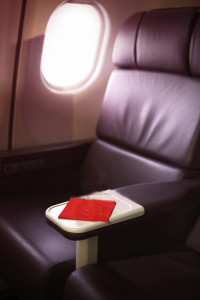
How FCF Classifies Economy Classes
Economy “Basic”: You can’t understand PE without know-ing what the aver-age economy class seat looks like, so here’s our police-artist sketch: A seat pitch of 30 to 32 inches, width of 17 to 18 inches, and a recline of 110 to 112 degrees.
Economy “Privileged”: These are seats in so-called privileged parts of the economy cabin, which usually means bulkhead or exit row seats. The seat offers at least two inches more legroom— which, for a sardine, is almost recognizable. (Don’t be fooled by seats that are a few rows be-hind the bulkhead or exit row seat, which airlines claim is a “better” seat; they have no extra legroom room.) For many airlines these seats are a revenue stream, often available for purchase online at a surcharge.
Premium Economy “Lite”: United is the pioneer of this product—a few rows of seats at the front of the economy cabin with extra legroom (35 to 36 inches). (Air Canada offers 38 inches by using old Business Class seats, but only offers them on three planes out of a fleet of 200, flying seasonal/holiday routes from Toronto and Montreal.)
Most airlines offer this kind of seat free of charge to their elite members—the higher your level, the greater claim you have. Delta only offers them to top-tier elites (Diamond and Platinum) for free; other elites have to pay up.

The Premium Economy Lite product offered by the airlines (noted in the chart on page 10) is available for purchase online or at the airport by non-elites. The price is usually based on the one-way fare and can range from $80 to $200.
Premium Economy “Elite”: This product—the real (Premium Economy) deal—is the best option for people accustomed to flying Business Class, especially on a day flight to Europe, where lie-flat beds aren’t much of a perk. These seats are in a separate cabin, have often been created for the cabin, and are often packaged with elite ground and onboard experience. For instance, PE comes with separate check-in and priority boarding, and maybe an amenity kit and special meal service depending on the airline.
Premium Economy Elite offers more legroom and more recline, OpenSkies wins the gold for the former (47 inches) and the latter (130 degrees). When it comes to width, though, the competition narrows. Every carrier’s PE seat is 18 to 20 inches wide, except for Virgin Atlantic, the wide-open winner at 21 inches. (Two and a half inches wider than many Delta Business Class seats.)
Premium Economy Elite has its own “booking code” and international published fares that range from $600 in low season on BA (plus taxes, NY-London; see our Feb. 28 alert for current BA and Virgin Atlantic promotional fares starting at $401 plus taxes) to $2,000 (LAX-London) in high season when booked in advance. PE Elite can be confirmed at time of booking in a separate booking class inventory, whereas PE Lite can’t—an important distinction
The Comfort Leaders
[table_opt style="gray-header" id="850 " width="" alignment="center" responsive="all" heading="thcenter" rows="tdcenter"]
Many international mileage programs allow you to redeem miles for Premium Economy Elite. Virgin Atlantic charges 55,000 miles from New York to London, 25,000 miles less than it charges for Business Class, and 25,500 more than economy. Some airlines even offer bonus miles and bonus elite qualifying miles (EQMs) for booking PE Elite. For instance, BA offers a 10% mileage bonus and 50% Elite Qualifying Points (EQP) bonus to AAdvantage members flying in Premium Economy.
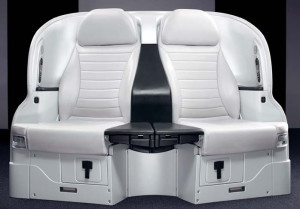
Cost difference between PE Lite, PE Elite, and Business Class
Looking at a Washington, DC to Paris round-trip in three categories: PE Lite, PE Elite, and Busi-ness Class, we see (below) the fare bump at each step: The difference be-tween the first two is only about $450 or about 6¢ per flight mile, and often worth buying. But the difference between PE Elite and Business Class is about $2,800 (72%), which is why so many corporate travel policies are opting for the former.
Route Availability
Air France, BA, and Virgin Atlantic offer the PE Elite cabin from Europe to destinations such as Africa and the Middle East.
Comparing The Fares
[table_opt style="gray-header" id="851 " width="" alignment="center" responsive="all" heading="thcenter" rows="tdcenter"]
[table_opt style="gray-header" id="854 " width="" alignment="center" responsive="all" heading="thcenter" rows="tdcenter"]
[table_opt style="gray-header" id="860 " width="" alignment="center" responsive="all" heading="thcenter" rows="tdcenter"]
The Puzzle Between Business Class and the Back of the Bus…
[aside headline="When To Go For Premium Economy" alignment="alignright" width="half" headline_size="default"]
Personal Travel
- When sleep is secondary to working on your laptop, why pay for 180-degree recline in Business Class?
- If you appreciate seat width the most, and can get more from PE than you can from Busi-ness Class at times (i.e. Virgin Atlantic versus Delta’s B767).
- When Business Class fares are high.
- When upgrade or mile-age award inventory is not available.
- When taking a family vacation and you are buying a lot of tickets (ask yourself if the kids really need to fly up front).
For Business Travel
- When company travel policy or client budget forbids Business Class.
- When you want to up-grade your employees.
[/aside]
In my January crystal ball (and even long before then, too), I predicted that Premium Economy (PE) would be this year’s high-flying cabin. Even though PE has been around since 1992, when it was first introduced by EVA and Virgin Atlantic, its potential has never really been consistently de-veloped by the airlines.But they’re looking harder at it now.
By this summer, Delta will begin offering Premium Economy on all domestic and international flights (transcontinental JFK-SFO/ LAX already have it), by January 2013 United will have its...