
How to Go Non-Stop, Coast-to-Coast Starting at $1,198 in Business Class
Last month, FCF did a deep dive into Delta’s transcon routes, showing how to save up to 44%.
This month we focus on JetBlue and Virgin America.
According to our research, JetBlue will offer the best of both worlds: new flat-beds seats and very low premium fares, when it starts transcon service in June.
Virgin America, on the other hand, is defiantly the opposite: old seats (with no plans for new ones) and high fares.
The JetBlue Transcon
It will introduce new premium seats in mid-June on Los Angeles-JFK. Keep a close eye on the airline because it currently offers the lowest fare and the new seat appears to be solid (22-inch-wide flat-bed).
The airline does not offer any Stopover Loophole Strategies or discount packages as far as we can tell, as do some of the other carriers we’ve mined deeply.
Seats: 12 flat-beds, called Mint, in a 2-2 layout and four in a suite, meaning a privacy door. There is no extra charge for the latter, which are offered first come, first served. Mint seats are 22.3 inches wide.
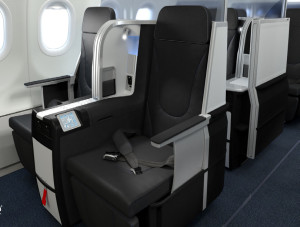
Fares: With everyday fares starting as low as $1,198 roundtrip—and when first announced (see Oct. issue) as low as $1,000—JetBlue is an EasyUp fare airline, meaning the fare is so low that it’s better to pay cash than to mess around with upgrade strategies, generally speaking.
Such low fares should cause some price cutting—if not all out fare wars from time to time—given that the other four carriers on the route charge double or more.
Award Tickets: TrueBlue, JetBlue’s frequent flyer program, charges based on fare paid, which means the price changes according to demand for seats. So a $1,200 round-trip runs 70,000 points, and goes up from there if demand is high. This only yields a return of 1.7¢ per point, and it’s also 20,000 more miles than American and United charge for Business Class.
This brings up an interesting question: how many paid Business Class tickets would it take to get a free ticket? TrueBlue members earn six points for every dollar spent with JetBlue, meaning it takes about 10 trips at $1,198 each to get a free flight—that is, if a seat is available at the lowest point rate.
Upgrade Award Tickets: No option to buy economy and use points for an upgrade. To get the seat, you pay in points or cash.
Getting Points: JetBlue is a transfer partner with Amex Rewards—so if you prefer using credit card points, it could be an option—and it also sells up to 60,000 miles per year at 3.8¢ each including taxes. It regularly offers 50% buying promos.
The Virgin America Transcon
Similar to Delta, in that it has no SLS savings and no package savings, and on top of that, it also has no new seat roll-out scheduled anytime soon. So here are our eight reasons not to use Virgin America.
Seat: As competitors start offering flat-bed seats with an international feel, Virgin’s will feel more dated fast (only 165-degree recline).
Fares: High, starting at $4,080 round-trip on LAX-JFK.
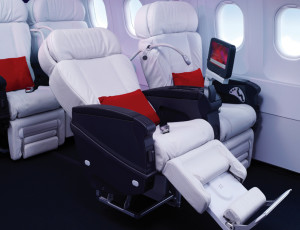
Newark Fares: Lower, starting at $2,854, $1,226 (30%) less than from JFK on Virgin America. But, American’s Newark fare is a much better deal, starting as low as $994 round-trip, a difference of $1,860.
Award Tickets: Elevate is the name of the airline’s program, and it charges points based on the fare paid (same as JetBlue). We priced many different dates and the lowest fare we found ($4,080) required 188,744 points. UA, which just completed its new seat roll-out on this route, only charges 50,000 miles round-trip and has plenty of low-cost award availability. Why would anyone want to pay more than three times more miles?
You can get Virgin America at a cheaper mileage rate (75,000 round-trips) through Virgin Atlantic. Availability is sometimes good, but the price is still 25,000 miles (50%) more than UA charges. Virgin America is a no-win situation.
[aside headline="Recap of Transcon Strategies with American, Delta and United" alignment="alignright" width="half" headline_size="default"]
American has the “Stopover Loophole Strategy (SLS)”, “Package Strategy”, and “Newark Strategy”; Delta has a new transcon fare; and United has good free and upgrade award availability, but no SLS or package savings. Without these strategies, a transcon flight can cost $3,500 to $4,400.
As far as the best seat for the money, the title goes to American, which offers an international First Class seat on its three-cabin trancons (starting as low as $991 through SLS; see FCF’s Oct. issue for details for details). Runners up are Delta, JetBlue, and United, which have (or will have) international-level, flat-bed Business Class seats, as does American in Business.[/aside]
Upgrade Award Tickets: No option to buy economy fares and use points for an upgrade. To get the seat you either pay in points or cash.
Getting Points: Virgin America is a point transfer partner with Amex Rewards, but the exchange rate is 2-to-1, meaning in order to get 189,000 Elevate points, you must transfer 378,000 Amex Rewards points. This is crazy. You could get two anytime award tickets from Delta (not known for being generous) for fewer miles (78,000) than Virgin American’s lowest single ticket.
Stopover Loophole Strategy (SLS): None as network is limited.
Package Strategy: None found.
With competition increasingly stiff, I see Virgin America being forced, at some point, to lower its fares, as it’s the only card in play.
The only bright spot our research turned up for this airline is that during certain holidays travel periods, such as July Fourth, Thanksgiving, and Christmas, Virgin America offers discounted transcon fares starting at $1,598.
Transcon Head-to-Head: American, Delta, JetBlue, United, and Virgin America
[table_opt style="blue-header" id="783 " width="" alignment="center" responsive="all" heading="thcenter" rows="tdcenter"]
How to Go Non-Stop, Coast-to-Coast Starting at $1,198 in Business Class
Last month, FCF did a deep dive into Delta’s transcon routes, showing how to save up to 44%.
This month we focus on JetBlue and Virgin America.
According to our research, JetBlue will offer the best of both worlds: new flat-beds seats and very low premium fares, when it starts transcon service in June.
Virgin America, on the other hand, is defiantly the opposite: old seats (with no plans for new ones) and high fares.
The JetBlue Transcon
It will introduce new premium seats in mid-June on Los Angeles-JFK. Keep a close eye on the airline because it currently offers the lowest fare and the new seat appears to be solid (22-inch-wide flat-bed).
The airline does not offer any Stopover Loophole Strategies or discount packages as far as we can tell, as do some of the other carriers we’ve mined deeply.
Seats: 12 flat-beds, called Mint, in a 2-2 layout and four in a suite, meaning a privacy door. There is no extra charge for the latter, which are offered first come, first served. Mint seats are 22.3 inches wide.