Remote parts of the world are tailor-made for monopolies. One carrier controls or two carriers split the route and they charge a premium because there’s no other choice.
[aside headline="Thinking Elite-Status Thoughts:" alignment="alignright" width="half" headline_size="default"]If you're married to one airline program it could mean having to make a connection to catch these great fares. The reason I say this is because elites are accustomed to rationalizing their loyalty with the idea that schedules are much better on their primary carrier—but that’s very often not the case. Take a traveler in Atlanta trying to get to New Zealand on a Delta partner. In that case you could pay about $4,400 more and spend about 10 more hours to arrive.[/aside]
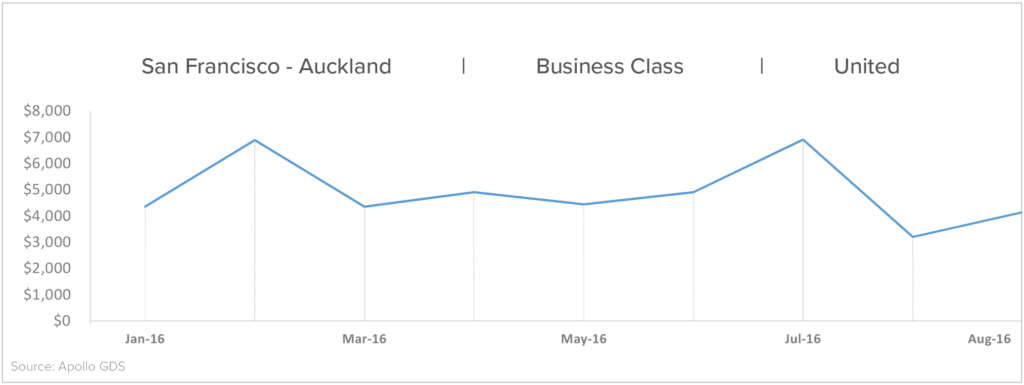
This has long been the case with New Zealand, where Business Class fares (even advance-purchase ones) from the U.S. to Auckland have generally run $6,000+, and almost never went on sale. Why? A monopoly of one, Air New Zealand, controlled the route non-stop from the U.S.
South Pacific Premium Fares Upended
Well, the monopoly has been disrupted. United started San Francisco-Auckland service on July 1 and American launched Los Angeles-Auckland on June 23. And there are now more backdoors to Auckland (via Sydney), given American’s Los Angeles-Sydney service (started Dec. 17, 2015) and Qantas’ San Francisco-Sydney route (started Dec. 18, 2015).
Thus, on July 7, something very rare happened: Air New Zealand and United reduced Business Class on San Francisco-Auckland from $4,899 to $3,499, a $1,400 drop. American, Delta, Qantas, and Virgin Australia matched the fare, but their flights require a connection. (See alert details here.)
United Fare Drama
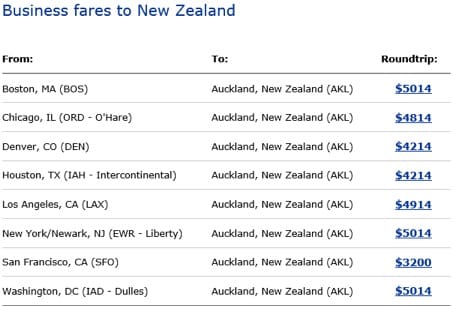
The bigger surprise regarding United is that it promoted the fare on its website—that’s usually forbidden in the airline world with many of its best fares. The carrier also offered an even lower fare, $3,200, if booked through a travel agent. But a few days later, United changed its mind and put that fare on its website. In for a dime, in for a dollar. (See screenshot below.)
How unusual is it to see deeply discounted premium fares on an airline website?
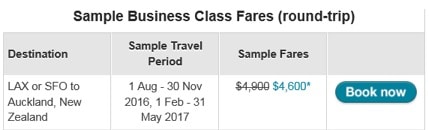
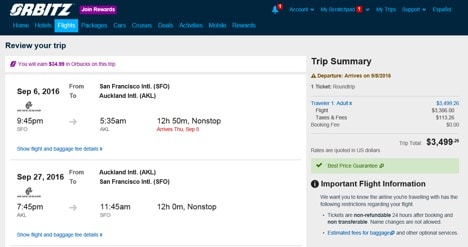
On July 12, Air New Zealand’s lowest advertised fares online (expired July 14) were $4,600, while at the same time, it sold the same flights through distribution channels like travel agents and Orbitz for $3,499. (See screenshots below.)
Air New Zealand Website:
Orbitz website:
New Fare Trend to the South Pacific? FCF Disagrees Internally.
I think so. Based on past experience, it starts with one route and spreads like prairie fire. It’s in keeping with the world-wide trend of declining Business Class fares. The South Pacific is overdue for a reality check—all it needed was capacity.
[aside headline="Anomaly Fares to Australia" alignment="alignright" width="half" headline_size="default"]The new Business Class fare to Auckland on United combined with an add-on Business Class fare—a second ticket—could have also been purchased to Sydney for $3,887, and to Brisbane and Melbourne for $3,993, see details here.[/aside]
Capacity = Competition to Fill Seats = Deals
Now, some of you might think, “Bennett, you are jumping the gun,” since one route does not equal a new fare trend. I know: One of my senior fare analysts told me just that.
She believes that this new fare was just a promotion to sell excess off-season inventory on a new route, which we seldom see.
Okay, but the bigger picture is that four new routes on a small market will affect how airlines will price premium air travel. There are almost never holiday, summer, or any other fare discounting to New Zealand (common practice in much of the world); but that could easily change with the fall of a monopoly route given the fight for market share.