
Your Ticket to a Quick Getaway
Sometimes it comes down to, “Just book it.” That’s the case with the fares you’ll find in this report. No multi-step strategies to follow, no mileage-partner back-flips to do. Just get these great fares while they last.
Premium Fare Values from the U.S. to Ten Resort Spots in Mexico Under $757 R/T
[table_opt id="5437" style="gray-header" alignment="thcenter" rows="tdcenter"]
How to Calculate What Amounts to “Free” and “Low-Cost Upgrades”
When Business Class fares are this low, it’s interesting to figure out which ones offer the most for your money. Just do a “cost-per-flight-mile” comparison. Simply divide the fare by the flight-mile distance to find out how many flight miles you get per dollar. The lower the cost-per-flight-mile, the better the deal, especially if you’re earning miles and elite credit. This winter, the difference between economy and Business Class will be as low as 5¢ per mile.
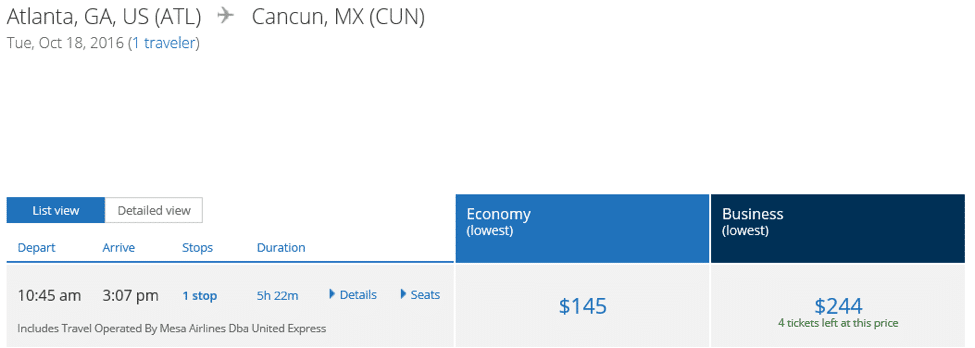
Take Atlanta-Cancun on United, which is 2,976 flight miles round-trip (connection in Houston). It has an EasyUp Business Class fare of just $488 round-trip, yielding a cost-per-flight-mile of about 16¢.
The lowest economy fare on this route at the moment is $290, a cost-per-flight-mile of about 10¢. For only 6¢ more ($99 one-way)—or about $20 per-flight-hour—you can book Business Class.
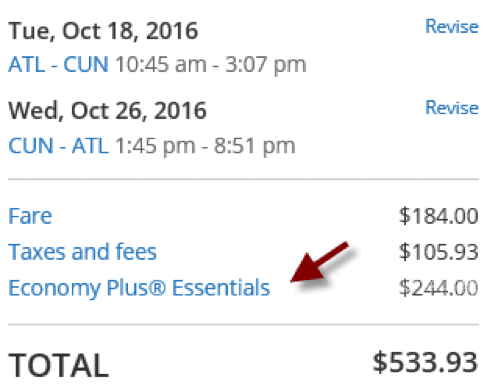
After you figure in all the fees economy class travel can include (Economy Plus Essentials is about $122 one-way just for an Economy Plus seat and one checked bag), the cost to upgrade can often be close to zilch or even less.
[aside headline="What are EasyUp Fares?" alignment="alignright" width="half" headline_size="default"]In short: An EasyUp Fare is an anomaly airfare that is surprisingly close in cost to the fare in the class below it.
You simply pay the First Class fare rather than the not-much-less Business Class fare, or pay the Business Class fare rather than the not-much-less coach fare.
Think of the relatively small dollar difference as the “fee” for your bargain upgrade… your easy upgrade. (No need to use miles, or work any other upgrade strategy.)
Mind you, airlines don’t call these fares EasyUp. FCF coined that term when it discovered them back in 2012.
And airlines seldom promote them.
But FCF’s team of global researchers find them, 24/7, making low-cost upgrading easy for members.[/aside]
Forget About Using Free or Upgrade Awards
Don’t Use Free Awards: This is because the value is so puny—on United less than 1¢ per mile given the cost, 60,000 miles round-trip. Your miles are worth much more to higher-priced destinations (Africa, Asia, the South Pacific), and for international First Class. Use miles for free award tickets when premium cabin fares are at least $4,000+, which yields at least a 4¢ return per mile, just a bit more than the replacement cost.
Don’t Use Upgrade Awards: This is because the economy ticket ($290) plus the co-pay ($250 round-trip) on United nearly equals (in this case, it is even more than) the published premium fare on many North American routes, once you add in the replacement value of the miles. Do the math: if the lowest economy fare + co-pay + cost of miles is lower than the published fare, just buy the ticket.
Don’t Bother with 2-for-1 Premium Fares
Delta offers this option to Mexico through the American Express International Airline Program. The drawbacks: Only the paid ticket earns miles and the applicable fares are now often much higher than Business and First Class fares. Use a 2-for-1 if the only alternative is a full Business or First Class fare on long-haul international flights, the result of missing the advance-purchase deadline or not meeting the minimum-stay requirement.
Your Ticket to a Quick Getaway
Sometimes it comes down to, “Just book it.” That’s the case with the fares you’ll find in this report. No multi-step strategies to follow, no mileage-partner back-flips to do. Just get these great fares while they last.
Premium Fare Values from the U.S. to Ten Resort Spots in Mexico Under $757 R/T
[table_opt id="5437" style="gray-header" alignment="thcenter" rows="tdcenter"]
How to Calculate What Amounts to “Free” and “Low-Cost Upgrades”
When Business Class fares are this low, it’s interesting to figure out which ones offer the most for your money. Just do a “cost-per-flight-mile” comparison. Simply divide the fare by the flight-mile distance to find out how many flight miles you get per dollar. The lower the cost-per-flight-mile, the better the deal, especially if you’re earning miles and elite credit. This winter, the difference between economy and Business Class will be as low as 5¢ per mile.
Take Atlanta-Cancun on United, which is 2,976 flight miles round-trip (connection in Houston). It has an EasyUp Business Class fare of just $488 round-trip, yielding a cost-per-flight-mile of about 16¢.
The lowest economy fare on this route at the moment is $290, a...