
FCF’s annual look at where Premium Travel has been and where we think it’ll go this year.
Happy New Year, FCF members, and welcome to 2020 and to more dynamic and ever-changing premium travel conditions, if 2019 taught us anything.
This is our annual look back at what happened last year, what surprised us, and what didn’t, as well as what our crystal ball (and 24 years of industry immersion) tells us about what’s ahead—with the goal of giving you tangible ammunition to fly best in 2020.
I’m bullish on the opportunities available for ambitious travelers eager to fly in premium seats for much less than rack rates, as long as they’re informed and thinking a bit ahead.
Looking Back: 2019
There was a lot of tactical fare action last year. Tactical fares are low fares on specific routes, regions, seasons, you name the reasons. Airline computers are getting more powerful so they can crunch the numbers to a fine grind, squeezing out every dollar of profit possible. Airlines are pricing every seat to sell by its departure date. (More on this in a minute.)
That means savvy travelers win when they know about the seats that are most vulnerable to going unsold. They are the ones that get slashed nowadays, by a lot.
That’s your ticket to flying premium for little more than coach.
At the same time, many FCF members scored big in 2019 with loyalty program strategies. Knowing the right airline partnership opportunities and loopholes made all the difference. They never get old.
For example, airlines offered sales on buying miles in 2019 with much greater frequency. So the idea of saving up to 90% on high-end tickets became much more obvious. Consequently, more and more FCF members are getting courageous with their buy- and transfer-miles strategies.
What Didn’t Surprise Us About 2019
The value of elite status programs continuing to decline came as no surprise. Airlines are requiring increasingly higher spending to earn elite status while selling the finite supply of perks to anyone on the street or with a co-branded credit card. Airlines made it increasingly clear on this point: money talks and loyalty can walk.
The continued decline of U.S. mileage programs in general also came as no surprise (another reason not to chase elite status and domestic airline miles). This is particularly true with American and United joining Delta’s dynamic-award pricing approach (charging whatever they want, often exorbitant rates). In other words, the value of U.S. airline miles for free premium award travel took a major hit in 2019. And we used to think mileage-award chart increases were bad. Time to get out of these currencies if you haven’t already, spend down your balances, and only earn U.S. airline miles by flying from now on. That’s it.
What Did Surprise Us in 2019
Where Tactical Fares Appeared
The increased precision with which airlines were willing and able to price premium seats wasn’t a surprise, but where it manifested was.
For example, huge summer discounts to Europe in premium cabins were predictable for years, and generally were available for travel June to August. In 2019, you could still buy tickets for huge summer 2020 savings but, what changed in 2019 is that the airlines have divided the summer into low and high Business Class fare months.
That seemed to come out of left field at the time, but it makes sense, as airline’s predictive models are more precise, knowing what travel months are slow and when premium seats might go unsold at the higher rates they’re really after.
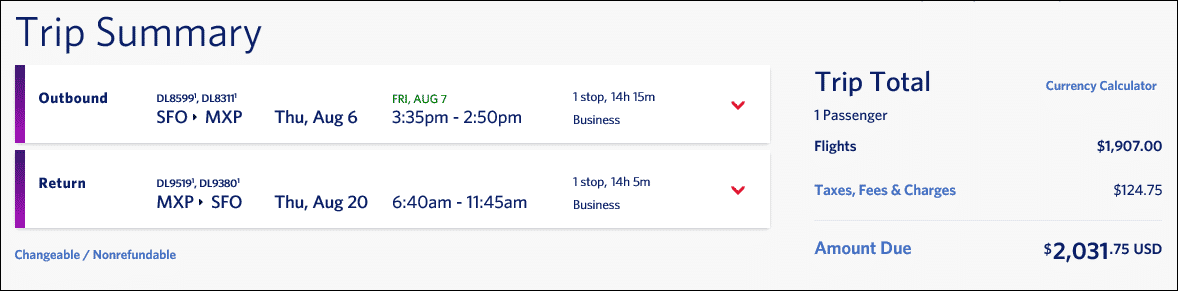
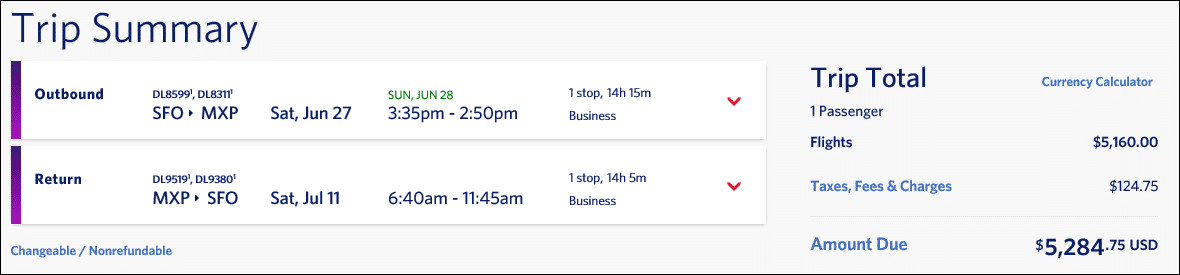
And the fare differences were not small, either. San Francisco to Milan in Business Class, for example, for travel in August 2020 runs just $2,032, compared to the June fare of $3,987 to $5,408. That’s a difference of $1,955 to $3,376 (49% to 62%).
That’s extraordinary for a two-month difference in the same summer travel season, which may be only 40 days apart.
See San Francisco-Milan Business Class Pricing,
Six Weeks Apart:
Very Low Business Class Fares to South America
It started in June with American offering Business Class fares to Córdoba, Argentina, starting at $1,437 from Miami, followed in July with $1,537 to Buenos Aires from Miami. But Delta put the icing on the cake by offering Business Class fares starting at $1,394 to Rio de Janeiro from New York in November. “Knock me over with a feather,” is one way to describe that.
In 2019 we were also delighted to discover…
East Coasters Are No Longer Favored When Flying to Europe
Like never before, the gap between West and East Coast Business Class fares were closing for travel to Europe. Many fares are now the same from either coast. This applied even to non-stop prime routes.
For example, just last month, both Los Angeles to London (5,437 miles) and Miami to London (4,426 miles) were priced the same: $2,266. This shouldn’t come as a surprise, however, as the local economies aren’t really different enough to warrant different pricing. In fact, one could argue it’s more painful to get to Europe from the West Coast because of the extra distance, so pricing should reflect some incentivization for those on the West Coast.
Something else we hadn’t seen before was that:
Premium Economy Fares OFTEN Cost Little More Than Coach
On non-stop routes, Premium Economy fares started at ~$747 with Delta on the Los Angeles-to-Shanghai route for about 26 hours of round-trip flying, which is only about $10 more per-flight hour than coach. Now, these kinds of Premium Economy fares of $750 to $900 might come to mind when flying to Europe, but we hadn’t seen these kinds of low fares to Asia much before.
This is great when you compare similar routes to Asia on United, such as Los Angeles to Tokyo (about 22 hours of round-trip flying), go for $1,470 in Premium Economy.
Four 2019 Premium Airfare Takeaways
Takeaway #1: What you paid in the past is no indication of what you’ll pay in the future. IOW: Fares are always changing—get used to it.
Takeaway #2: Maybe I’m splitting hairs here, but airlines shifted away from pricing seats as high as they could to generate as much revenue as possible, to pricing them more strategically, and often on a flash-sale basis, to sell ALL seats. They saw less value in leaving unsold seats at a high price or by “giving” them to loyalty programs members via good mileage availability instead of rotting like tomatoes, as they have in the past.
Now, instead, they sell them for cash and are increasingly shameless about undercutting themselves, even while releasing increasingly fewer premium mileage seats.
So what does this mean for you? Essentially, it means airlines are changing your behavior by enticing you to book dates they want you to book, so all the seats get sold. According to this approach, the August shift for discounts to Europe that we saw in 2019 makes sense. If they discount all summer months equally, they’ll have many seats left over in August. So, they price June fares highest, July a bit less, and August cheapest. Lower demand means lower price. The result? They sell all their seats.
If you take away nothing else, remember this: Fly when the airlines want you to fly and you can save 50%+ off.
Takeaway #3: Look for fares to be increasingly counterintuitive, such as those to Europe we discussed above that are priced the same from both coasts.
Takeaway #4: Expect flash Premium Economy fares to be little more than coach.
So What?
The more you know, the more informed and open-minded you are. The more open-minded you are, the more opportunity will reveal itself to you.
As the saying goes, “When the student is ready, the teacher will appear.” The same holds true for the premium traveler: When the Opportunity Traveler is ready, opportunities will appear. If only because airlines are now willing to do whatever it takes to sell all their seats, even if they have to undercut themselves significantly.
It’s simple, really: Just follow the money to fly in comfort for less.
So much for history; 2019 is so last year. Let’s look at what we think might happen in 2020.
2020 Visionaries. What We Think Will Happen and How You Can Win
Business Class in 2020
FCF predicts that the only way you’ll be able to use miles with American and United in Business Class in 2020 is to upgrade—unless you want to pay triple or even more miles for a free award ticket, that is.
The old days are over when Delta was the only one charging three times the amount of miles for free awards. But not to worry; you already know that FCF has a secret workaround for Delta, which we’ve covered over no less than seven special reports on the Delta-Virgin Loophole, the most recent one being in November.
How to Burn Points in 2020
So, if you don’t want to pay triple the price for free awards with U.S. airlines, then use your points with airline points-transfer partners which offer much better availability at normal or discount prices. Namely, Air France, All Nippon, Asiana, British Airways, Cathay Pacific, Emirates, Iberia, KLM, Qantas, Singapore, and Virgin Atlantic have more low-cost mileage award space for many months, routes, and seats.
Here’s our new year’s resolution for you: Get a credit card that transfers to most of these airlines if you don’t already have one. We suggest an American Express card, as points can be transferred from its program, Membership Rewards, to 10 out of the 11 airlines mentioned above.
Whatever you do, don’t use an American, Delta, or United co-branded credit card! Keep an eye out for more on our favorite cards for 2020 next month.
Obviously, the best time to use miles is when airfares are high. So always check published fares as new low tactical Business Class fares often appear that offer a better alternative. Stay flexible and keep your eyes open. We’ll help you there.
FCF predicts that in 2020 we will see a lot more tactical Business Class mileage award flash sales on U.S. airlines. Yes, that means mileage awards discounted on certain dates and routes, and offered only on a flash-sale basis, with perhaps a similar frequency and breadth of flash airfare sales, its half brother.
In other words, I envision yield management departments (the fare setters) and award-availability departments will collaborate closely in 2020.
FCF’s Old Faithfuls Still Apply
Our buy-miles-to-fly-in-style strategy is still one of the best ways to get Business Class tickets inexpensively to high-fare destinations such as the South Pacific or high-fare airlines like Cathay Pacific or Emirates. Just jump on a miles sale when they come up (as they often do) or, better yet, kick back and follow FCF’s alerts and we’ll tell you when sales become available, along with their companion, good availability to use them.
Cash Is King When Airlines Get Tactical
If 2019 is any indication of 2020 fares, then there are probably lots more surprises in store, such as new tactical fare travel seasons and destinations.
In other words, airlines will drop the prices of their Business and First Class fares during certain months and to certain destinations to remain competitive or to sell unsold seats much more often in 2020. The Opportunity Traveler (that’s you) will win big by going when and where those tactical Business Class fares become available—often to prime destinations and travel seasons.
That’s because the tactical fares we saw in 2019 can, and most likely will, change in 2020 as they’re an ever-moving target.
So, keep a generous bucket list handy and hit the destinations first that offer Business or First Class vacations for little more than coach.
How Tactical Will Airlines Get?
No one knows, but I can reveal that I was at an industry conference in October and one (very) large airline’s revenue/yield manager said that his airline is “as aggressive as ever to sell unsold seats.”
“Unsold seats” are the magic words. It tells me that everything is on the table: months, destinations, even days. FCF alerts and articles will capture and share the trends with you.
Lost and Not Found Department:
Mileage Program Value
Look for devaluation to continue in 2020 with the big three U.S. airlines—American, Delta and United—whose mileage programs are in free fall when it comes to charging miles for a ticket. This year will only get worse. The airlines can get away with this because most travelers aren’t knowledgeable or passionate enough to protest sufficiently to slow or stop the trend, like they used to be. Domestic loyalty programs will lose 25% to 50% of their value in 2020. One of the many reasons you don’t want to earn and save miles with American, Delta, or United co-branded credit cards.
For example, even though American Airlines has an “official” award price chart, it charges whatever it darn well likes for an anytime award nowadays. Going by the chart, the highest rate for Los Angeles to Sydney in Business Class should be no more than 195,000 miles one-way. But in reality, American charges as much as 480,000 miles one-way. Talk about “off the charts.”
FCF predicts that fares and miles management will align like never before, and that you’ll only see low awards when you see low fares. That’s good if you’re flexible, horrible if you’re not.
First Class in 2020
FCF predicts that British Airways will continue to be the price leader when offering First Class tickets with cash, compared to other airlines such as Lufthansa or Emirates. That said, we expect to see this on First Class flights to many regions, not just Europe, but Africa, India, and the Middle East as well.
Moreover, this will inevitably compel other airlines to lower fares to some degree, so look for the lowest First Class fares you’ve seen in decades, this year.
Up Your First Class Game
When it comes to using miles for low-cost First Class award space, look to international airlines. Keep this in mind: Fly All Nippon or Cathay Pacific to Asia and Emirates to the Middle East and even onward to Africa. And watch for rare First Class award space on Qantas to Australia and Singapore to Asia, which does come up from time to time. (If you’re flexible, don’t forget that you can bank on ‘rare’ deals.) We’ll keep you in the loop so that can happen.
Conclusion
To win in 2020, you might need to reset your travel flight path to “manual” instead of “autopilot.” As the famed military strategist Sun Tzu said, “In the midst of chaos, there is also opportunity.”
So expand your worldview. Get out your atlas and find new places to go. Some idea starters are here and here. And don’t give your heart away to any one airline. The more places you’d like to go, the more opportunities will fall in your lap.
Embrace the challenge—and enjoy 2020!

FCF’s annual look at where Premium Travel has been and where we think it’ll go this year.
Happy New Year, FCF members, and welcome to 2020 and to more dynamic and ever-changing premium travel conditions, if 2019 taught us anything.
This is our annual look back at what happened last year, what surprised us, and what didn’t, as well as what our crystal ball (and 24 years of industry immersion) tells us about what’s ahead—with the goal of giving you tangible ammunition to fly best in 2020.
I’m bullish on the opportunities available for ambitious travelers eager to fly in premium seats for much less than rack rates, as long as they’re informed and thinking a bit ahead.
Looking Back: 2019
There was a lot of tactical fare action last year. Tactical fares are low fares on specific routes, regions, seasons, you name the reasons. Airline computers are getting more powerful so they can crunch the numbers to a fine grind, squeezing out every dollar of profit possible. Airlines are pricing every seat to sell by its departure date. (More on this in a minute.)
That means savvy travelers win when they know about the seats that are most vulnerable to going unsold. They...